
Jason Fink, BS, OMS1; Arash Badragheh, BS, OMS1; Andrew Young, BS, OMS1; Kartik Varsani, BS, OMS1; Michael O’Dell, MS, OMS1; Bradley A. Fink, DO2
1Philadelphia College of Osteopathic Medicine
2Northeastern Orthopedics, Temple University Health System
Abstract
Insidious metacarpophalangeal (MCP) pain, stiffness, and swelling are typically attributed to inflammatory diseases such as rheumatoid arthritis and systemic lupus erythematosus, crystalline arthropathy, and hemochromatosis. Metacarpal head avascular necrosis (AVN), a rare cause of MCP dysfunction, but may be underdiagnosed and underreported. As a result, there is a lack of understanding of the natural progression of this disease as well as a lack of consensus regarding treatment guidelines. The authors hope to bring awareness and knowledge of Dieterich’s disease and to lay out the foundation for disease staging and treatment.
Keywords: Dieterich’s disease, Mauclaire’s disease, avascular necrosis, metacarpal head
Introduction
Avascular necrosis of the metacarpal head, or Dieterich’s disease, is a rare cause of hand pain, swelling, and dysfunction. (1) The pathophysiology involves arterial compromise to the metacarpal head followed by osteonecrosis, subchondral collapse, and arthritis. Symptoms develop insidiously, and numerous risk factors have been identified. Physical findings include; tenderness, edema, deformity, and stiffness. X-rays may be negative, and MRI is the study of choice for early detection. (1,2,3,4) Treatment depends on patient age, activity level, joint stability, bone quality, and the condition of the articular hyaline cartilage. (1)
Conservative management is initially recommended however surgery may be instituted if non-operative treatment fails. Both non-operative care and surgical intervention have proven effective. Dieterich’s disease is likely under-diagnosed due to its vague presentation, subtle clinical and x-ray findings, and physician unfamiliarity. (5) Early diagnosis requires a high index of suspicion to avoid progression and subsequent chronic hand symptomatology. (3) Based on a worldwide literature review, the authors have proposed a staging classification and surgical management algorithm to assist in treatment.
History
Metacarpal head osteonecrosis was first published by P. Mauclaire in 1927 and further described by H. Dieterich in 1932. Dieterich’s disease occurs mainly in the third metacarpal of the dominant hand in children and adults with a 3:2 male predominance. (1,2,3,4,5,6,7,8,9) This is an understudied disorder with just over 50 published cases worldwide. Prevalence and precise etiology are unknown. (1,10)
Risk Factors
Metacarpal fracture and MCP dislocation may lead to venous pooling which compresses the periosteal arteries and increases intramedullary pressure resulting in head ischemia. (1) Acute trauma and repetitive micro-trauma produce MCP effusion which may tamponade the periosteal arteries and pericapsular arterioles leading to a decrease in metacarpal head perfusion. (1,5,7,10,11,14,15) Corticosteroid therapy stimulates adipogenesis and increased chylomicron size resulting in arteriole fatty embolus and increased intraosseous pressure with resultant head ischemia. (1) Lupus vasculitis causes head ischemia through pericapsular arteriole vasospasm. (1) Hypercoagulability causes thrombosis within the microcirculation of the metacarpal head. (1) Periosteal stripping during metacarpal ORIF is an iatrogenic cause of head ischemia. (1) Identified risk factors are listed in Table 1.
| Risk Factors |
| Idiopathic |
| Acute Trauma |
| Corticosteroid |
| Lupus Vasculitis |
| Chronic Repetitive Microtrauma |
| Alcohol Abuse |
| Hypercoagulability |
| Iatrogenic |
Table 1: Risk factors of Dieterich’s disease (1,2,3,4,6,8,9,11,12,13)
Anatomy
In a study of 10 cadaveric arms, the nutrient artery to the metacarpal was absent 35% of the time in which perfusion to the head depends solely on the pericapsular arterioles. Sixty percent of these absences occurred in the long finger metacarpal. (7) This may explain why the third metacarpal has been found to be the most affected. This aberrancy, when paired with one or more risk factors, may lead to AVN.
Dieterich’s disease is similar to, but less common than Freiberg’s infraction which involves the metatarsal head and is also due to AVN. (7) This may be due to higher repetitive loads placed upon the foot rather than the hand. (7) In addition to the vascular aberrancy sometimes associated with the third metacarpal, it is likely that its structural prominence may also predispose it to AVN as is the case with the second metatarsal in Freiberg’s infraction. (7) Metacarpal and metatarsal prominence predispose their phalangeal articulation to repetitive, trivial micro-traumatic loading which may produce joint effusion and secondary tamponade of the pericapsular arterioles. (11,14,15)
Objective Findings
Symptoms of this disorder include; pain, swelling, crepitus, and MCP stiffness. In early stage AVN, x-rays are negative while later stages show metacarpal head lucency (cystic osteopenia), subchondral sclerosis, flattening, and MCP arthritis. Figure 1 demonstrates cystic/sclerotic changes in the second metacarpal head consistent with stage II AVN.
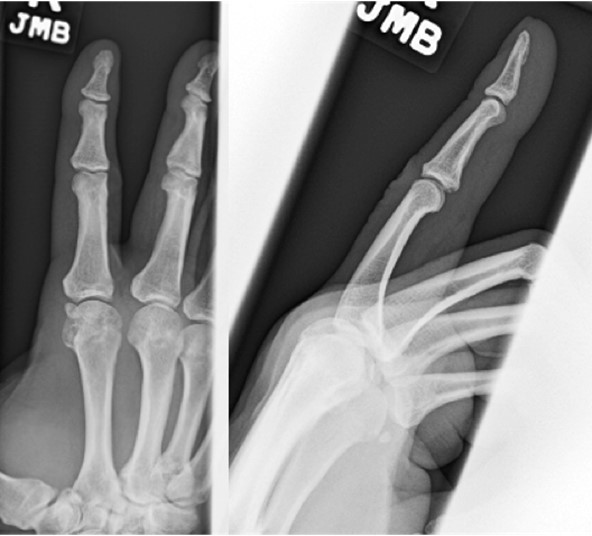
Fig. 1: AP, lateral right index finger showing stage II AVN of the 2nd metacarpal head
Figure 2 shows metacarpal head flattening and MCP arthritis consistent with stage IV AVN.
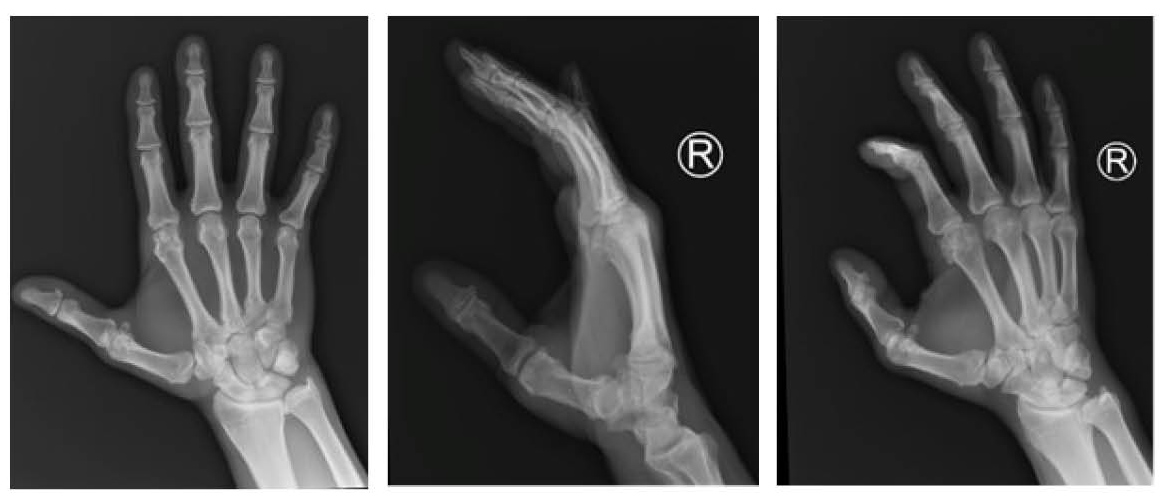
Fig. 2: AP, lateral, oblique right hand showing stage IV AVN of the 2nd metacarpal head.
MRI reveals subchondral marrow edema, a nidus of necrotic bone, subchondral collapse, joint effusion, and possibly an occult fracture (infraction). See figure 3.
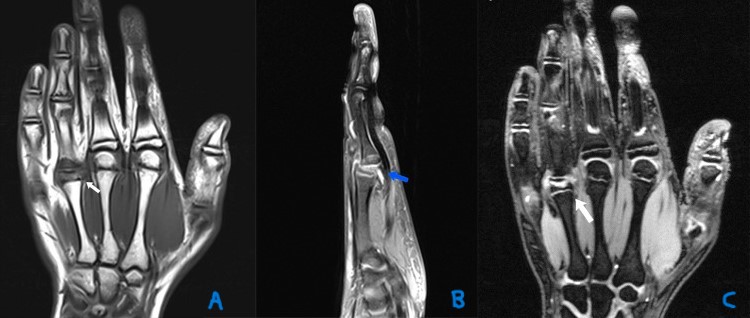
Fig. 3: (A) Coronal PD-FS and (B) sagittal T2 weighted images of the left hand depict subchondral marrow edema in the fourth metacarpal head (white arrow), with minimal joint fluid and volar displacement of the proximal fourth phalanx over the abnormal metacarpal head (blue arrow). (C) Coronal T1 weighted image of the left hand shows flattening and irregularity of the fourth metacarpal head with hypointense marrow signal in the subchondral bone (white arrow). Image source: Ginnaram AR, Kumar S, Ladumor HB, et al. (March 29, 2024) Metacarpal Pain Unveiled: A Case Report and Literature Review of Dietrich’s Disease in Adolescence. Cureus 16(3): e57214. DOI 10.7759/cureus.57214
Conservative Management
Non-operative treatment may be considered for adults and children. (1,8,16) There is no consensus as to the indication for non-operative treatment or how long non-operative treatment should be continued before transitioning to surgical intervention. Some authors recommend 3 to 6 months of non-operative treatment before recommending surgery. (1,13) Bracing for 2-6 weeks has been suggested. (1) Corticosteroid injection may be used to treat secondary osteoarthritis. Metacarpal head regeneration has been demonstrated in children with head collapse after non-operative treatment. (1,2,6,10,12,13,17,18) Metatarsal head collapse in adults have also demonstrated successful outcomes when treated non-operatively. (1,9,14) Non-operative treatment options are listed in Table 2.
| Non-Operative Treatment Options |
| Bracing |
| NSAIDs |
| Occupational Therapy |
| Corticosteroid Injection |
Table 2: Non-operative treatment options for Dieterich’s disease (1,2,3)
Surgical Management
The frequency of converting from failed non-operative treatment to surgical intervention is unknown. Due to the low volume of published surgical cases, success rates have not been able to be statistically evaluated or compared. This has led to a vast number of proposed surgical techniques with no consensus on when to operate or what procedure to choose. Curettage works by removing necrotic subchondral bone while serving as a core decompression to decrease intraosseous pressure and allow for reperfusion of the metacarpal head through neovascularization. Curettage with cancellous autografting has yielded successful outcomes despite metacarpal head collapse. (1,9,14) Arthrodesis and arthroplasty are salvage procedures. Osteotomy serves to rotate the damaged volar hyaline cartilage away from articulating with the proximal phalanx while bringing the healthy dorsal articular cartilage into a load bearing position as well as to decrease the joint reactive force by decreasing collateral ligament tension. (1)
Surgical treatment options for Dieterich’s disease are listed in Table 3.
| Surgical Treatment Options |
| Curettage With Or Without Cancellous Autografting (From Distal Radius) |
| Arthrodesis |
| Total Joint Replacement (TJR) |
| Hemiarthroplasty |
| Open Wedge Metacarpal Neck Flexion Osteotomy |
| Second Metatarsal Head Autogenous Transplantation |
| Costal Osteochondral Metacarpal Head Autografting |
| Osteochondral Autograft Transplant Surgery – OATS (From Knee) |
| MCP Sensory Denervation |
| Metacarpal Head Multiple Drilling Chondroplasty And Synovectomy |
| Osteochondral Mosaicplasty |
| Fascial Interposition Arthroplasty |
| Resection Arthroplasty |
Table 3: Surgical treatment options for Dieterich’s disease (1,2,3,4,10,12,15,19,20,21)
Classification and Surgical Management Algorithm
A failure in early recognition of Dieterich’s disease with the subsequent delay in patient presentation has resulted in the inability to establish a definitive management guideline and procedural standardization protocol. (1,2,5,6,12,19) Hence, there is no clear consensus regarding optimal treatment. (1,8,9,13,15,19,20) The primary treatment goal is for metacarpal head preservation, especially in younger and active patients. (19) Long-term prognosis is unknown and is determined by metacarpal head collapse and subsequent articular cartilage damage. (1,2,3,4,10,12,15,19) The authors present our staging classification in Table 4 which is the basis for our proposed surgical treatment algorithm shown below in Figure 3. Staging is based upon metacarpal head articular cartilage viability as assessed intraoperatively and radiographically.
| Stage | X-Ray | MRI | Articular Cartilage |
| I | Negative | Positive | Normal |
| II | Cystic/Sclerotic | Positive | Normal |
| IIIa | Flattening | Positive | Normal |
| IIIb | Flattening | Positive | Focal Head Defect |
| IIIc | Flattening | Positive | Diffuse Head Involvement |
| IV | Arthritis | Positive | Joint Involvement |
Table 4: Authors classification of metacarpal head AVN
Our surgical treatment algorithm considers the articular cartilage involvement (stage), patient age and activity level, joint stability, and bone quality.
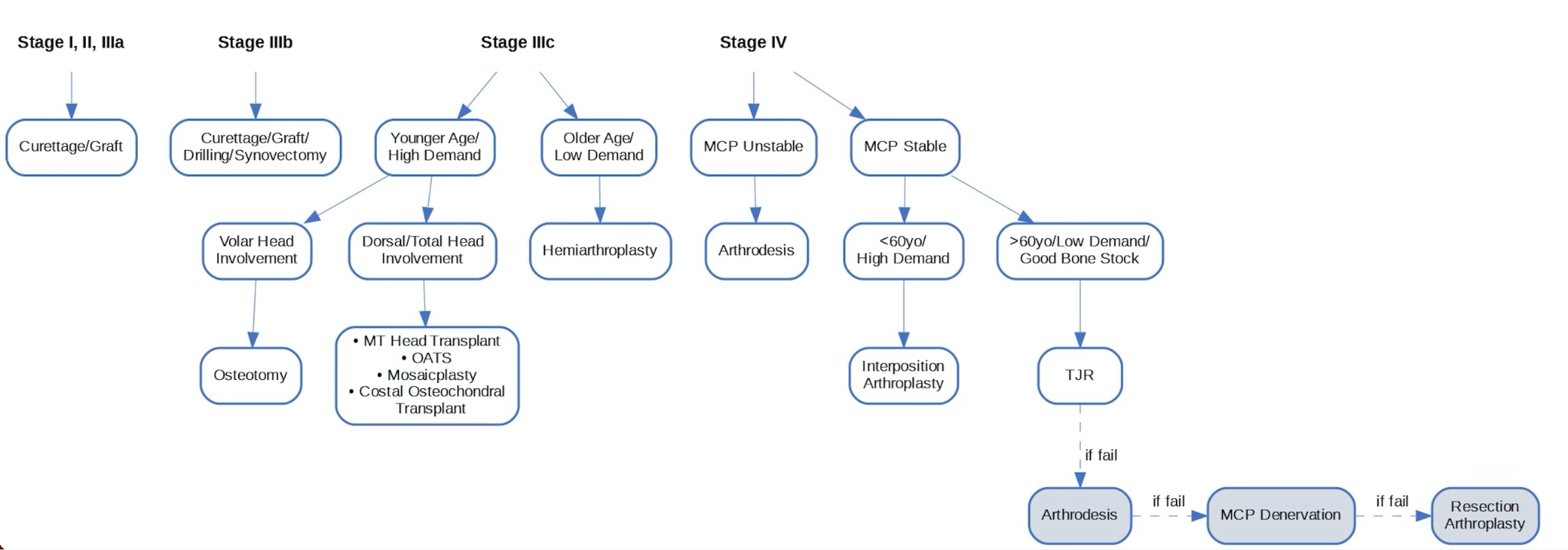
Fig. 3: Authors surgical management algorithm for Dieterich’s disease
Conclusion
After almost a century, our understanding of the cause, treatment, and prognosis of Dieterich’s disease is limited. (1) Due to its rarity, only limited case reports exist as no large scale, long-term prospective or retrospective studies have been published. As a result, clinicians are often unfamiliar with the condition which, in addition to its insidious presentation and vague findings, may allow it to go undetected and misdiagnosed. (1,22) This would allow for disease progression from early to late stage, changing the treatment option and worsening the prognosis. Our review article aims to increase awareness of Dieterich’s disease so that early diagnosis and timely intervention may be provided to preserve joint function and prevent the progression to chronic pain and stiffness from arthritis. (9,10) Additionally, our staging classification system and surgical management algorithm may be used to provide treatment guidance.
Consent For Publication
Informed consent was obtained from the patient who agreed to permit the use of their radiographs in this publication.
Conflict of Interest
There are no known conflicts of interest associated with this publication.
Funding Statement
No financial support or sponsorship was received for this publication.
IRB/Ethics
Approval not applicable.
References
- Fan XL, Wang WT, Wang J, Xiao R. Current management of avascular necrosis of the metacarpal head: a comprehensive literature review. Int J Surg. 2023; 109(5): 1509-1517. doi: 10.1097/JS9.0000000000000377. PMID: 37042565; PMCID: PMC10389567.
- Aldekhayel S, Ghanad E, Mudgal CS. Avascular Necrosis of the Metacarpal Head: A Review of 4 Cases. J Hand Surg Am. 2018; 43(11): 1037.e1-1037.e5. doi: 10.1016/j.jhsa.2018.03.002. Epub 2018 Apr 3. PMID: 29625798.
- Karlakki SL, Bindra RR. Idiopathic avascular necrosis of the metacarpal head. Clin Orthop Relat Res. 2003; 406: 103-8. doi: 10.1097/01.blo.0000030168.56585.cb. PMID: 12579007.
- Conesa X, González X, Siles E, Parals F, Novell J. Simultaneous development of Dieterich disease and Freiberg disease. J Foot Ankle Surg. 2013; 52(3): 389-92. doi: 10.1053/j.jfas.2012.12.014. Epub 2013 Jan 28. PMID: 23363812.
- Ahuja K, Gandhi D, Hernandez-Delima FJ, Sharma P, Gupta N, Kier R. Osteochondroses of the bilateral metacarpal heads: Dieterich disease. A case report with review of the literature. Clin Imaging. 2020; 67: 7-10. doi: 10.1016/j.clinimag.2020.05.020. Epub 2020 May 29. PMID: 32497998.
- Vaz A., Pedrazzani BM., Bosquirolli P. Metacarpal epiphyseal lesion. European Society of Radiology Eurorad. 2020. https://doi.org/10.35100/eurorad/case.16923.
- Wright TC, Dell PC. “Avascular necrosis and vascular anatomy of the metacarpals.” The Journal of Hand Surgery. 1991; 16.3: 540-544.
- McGoldrick NP, McGoldrick FJ. Avascular necrosis of the metacarpal head: a case of Dietrich’s disease and review of the literature. Am J Case Rep. 2015; 16: 12-5. doi: 10.12659/AJCR.892389. PMID: 25594915; PMCID: PMC4296845.
- Li W, Liu B, Song J, Liu, Y, Liu H, Pei S, Wei Z, Zhang J, Dong M. Bilateral multiple metacarpal head avascular necrosis: A case report. International Surgery. 2016; 101(9–10): 473–477. https://doi.org/10.9738/intsurg-d-16-00010.1
- Wijeratna MD, Hopkinson-Woolley JA. Conservative management of Dieterich disease: case report. The Journal of Hand Surgery. 2012; 37.4: 807-810
- Gannon JM., Engebretsen L, Aamodt A. Avascular necrosis of the metacarpal head in a shot-putter. Scandinavian Journal of Medicine & Science in Sports. 1995; 5: 107-109. https://doi.org/10.1111/j.1600-0838.1995.tb00022.x
- Maes M, Hansen L, Cheyns P. Osteochondral mosaicplasty as a treatment method for bilateral avascular necrosis of the long finger metacarpal: case report. J Hand Surg Am. 2010; 35(8): 1264-8. doi: 10.1016/j.jhsa.2010.04.014. PMID: 20684926.
- Drissi-Kaitouni M, Ruijs ACJ. Dieterich’s disease of both the third and the fourth metacarpal head in a teenage boy: case report and review of literature. Case reports in plastic surgery & hand surgery. 2024; 11(1): 2316026. https://doi.org/10.1080/23320885.2024.2316026
- De Smet L. Avascular necrosis of the metacarpal head. Journal of hand surgery (Edinburgh, Scotland). 1998; 23(4): 552–554. https://doi.org/10.1016/s0266-7681(98)80149-6
- Sagar P, Shailam R, Nimkin K. Avascular necrosis of the metacarpal head: a report of two cases and review of literature. Pediatric radiology. 2010; 40(12): 1895–1901. https://doi.org/10.1007/s00247-010-1763-y
- Ginnaram AR, Kumar S, Ladumor HB, Mohanan S, Murphy JW. Metacarpal Pain Unveiled: A Case Report and Literature Review of Dietrich’s Disease in Adolescence. Cureus. 2024; 16(3): e57214. doi: 10.7759/cureus.57214. PMID: 38681334; PMCID: PMC11056241.
- Schmidt I. The idiopathic avascular osteonecrosis of the third metacarpal head (M. Mauclaire/Dieterich’s disease). Int J Case Rep Images. 2017; 8(2): 92–95.
- Kalenderer O, Ağuş H, Ozlük S. Uçüncü metakarp başinin avasküler nekrozu: Olgu sunumu [Avascular necrosis of the third metacarpal head: a case report]. Acta orthopaedica et traumatologica turcica. 2004; 38(2): 154–156.
- Liyun Jiang MB, Zongping Xioa MB, Teng Chen MM, Rui Jiang MM. A commentary on ‘Current management of avascular necrosis of the metacarpal head: a comprehensive literature review’. International Journal of Surgery. 2024; 110(8): 5192-5193. doi: 10.1097/JS9.0000000000001486
- Hu MH, Chen WC, Chang CH. Idiopathic osteonecrosis of the third metacarpal head. Journal of the Formosan Medical Association = Taiwan yi zhi. 2008; 107(1): 89–92. https://doi.org/10.1016/S0929-6646(08)60014-5.
- Thienpont E., Vandesande W, De Smet L. Dieterich’s disease: avascular necrosis of the metacarpal head: a case report. Acta orthopaedica Belgica. 2001; 67 (2): 182–184.
- Núñez PM, Vegas MJ, González MP. Dieterich’s disease: A case report of a very rare disease. Revista Colombiana de Reumatología (English Edition). 2021; 76–79. doi:10.1016/j.rcreue.2020.03.005.
- Barnes NA, Howes AJ, Jeffers H, Carty H. Quiz Case. European Journal of Radiology. 2000; 36: 115-117.
- Saliba T, Simoni P, Boitsios G. A Painful finger- answer: Dieterich’s disease. Skeletal Radiology. 2024; 53: 1227-1228.
- Green DP. Mauclaire’s Disease. Journal of Hand Surgery. 2011; 36A: 757
- Ares O, Seijas R, Conesa X, Pedemonte J. Avascular necrosis of the metacarpal head: Dieterich’s disease. Acta Orthopaedica Belgica. 2008; 74: 693-696.
- Carstam N, Danielsson L. Aseptic Necrosis Of The Head of the Fifth Metacarpal. Acta orthop. Scandinav. 1966; 37: 297-300.