
Jordan R. Read, DO, ATC; Jeffery A. Gibson, DO; and Amy Tucker, MD
Western Reserve Hospital
DOI: http://doi.org/10.70709/cdbycgudy
Abstract
Introduction
Hip fractures are devastating and debilitating injuries. There are approximately 2 million hip fractures worldwide each year, rapidly creating a major public health issue.1 Decline in functional status leads to increased morbidity and a 1-year mortality of 20-33%.1,2 Pre- and post-operative pain control can be difficult to manage in an aging population; opioids remain the mainstay treatment.2 Opioids can have significant side effects, including nausea, vomiting, constipation, delirium, and respiratory distress.2 Acetaminophen is safe to administer orally, rectally, and intravenously (IV) with less significant side effects compared to opioid administration.3
Purpose
To determine if the administration of post-op IV acetaminophen for hip fracture patients over 55 years old reduced the pain level, length of stay, and amount of opioids required for adequate postoperative pain control compared to patients who did not receive IV acetaminophen.
Method
Retrospective data analysis was performed on all hip fracture patients from January of 2020 to January of 2024. Beginning November 1, 2022, IV acetaminophen was administered postoperatively to hip fracture repair patients over the age of 55 as part of a standardized pain regimen. Patients were excluded from the study if they did not receive IV acetaminophen after November 2022.
Results
280 total patients. Control group- 233 patients, IV Acetaminophen group- 47 patients. Analyzed with Wilcoxon Rank Sum testing. Median pain at 12, 36, and 72 hours was statistically significantly lower for the IV Acetaminophen group. Median length of stay was unchanged at 5 days for both groups.
Conclusion
We found that a post-op pain regimen including IV Acetaminophen lowered hip fracture patients’ reported pain and reduced the total amount of narcotics received. We recommend IV Acetaminophen as an effective option in managing postoperative pain for hip fracture patients over 55 years old.
Keywords: Hip fracture, acetaminophen, post operative pain control, femoral neck fracture, intertrochanteric fracture
Introduction
With the increases in the aging population, geriatric hip fractures are creating a public health concern. It is well established in the literature that these injuries carry significant morbidity and mortality rates and can be significantly debilitating. Even with operative fixation, 1-year mortality rates can remain as high as 20-33%.1,2 There are an estimated 2 million hip fractures that occur worldwide, with more than 273,000 of these occurring in the United States. It is estimated that the cost burden for these fractures is approximately $30 billion annually, with the expectation that the incidence and cost burden of fractures is going to continue to increase. 1
Factors that complicate the management of these fractures include pain control in the pre- and postoperative setting.
The current mainstay for pain control in geriatric hip fractures is opiate medications, which is not without its own set of concerns or issues. 2 Opiate medications can have a more pronounced side effect profile in the geriatric population, which can include nausea, vomiting, constipation, delirium, and respiratory distress. Secondary complications include prolonged bed rest and delays in weight-bearing and therapy. As part of a multimodal pain control plan, acetaminophen and nonsteroidal anti-inflammatory drugs (NSAIDs) are recommended when not contraindicated. Acetaminophen is generally a safe and effective analgesic that can be administered in oral, rectal, and intravenous forms. 3,4 There are significantly fewer side effects when compared to opiate medications and has become a mainstay for multimodal pain management. It may not be possible or feasible to eliminate all opiate use in the pain control of geriatric hip fractures, but it should be a goal to reduce the opiate requirements when managing pain.
This was the focus of a quality improvement project performed at a level 3 community trauma hospital, to evaluate if the administration of postoperative IV acetaminophen for hip fracture patients over 55 years old reduced the pain level and reduced the amount of opioid pain medication given. Our secondary objectives evaluated whether patients’ length of stay and discharge location (i.e. discharge to skilled nursing, acute rehab, hospice, etc.) were affected by the administration of IV acetaminophen. We hypothesized that post-op administration of IV acetaminophen would reduce post-op pain and opiate requirements for hip fracture patients over the age of 55.
Method
From January 2020 to January 2024, a retrospective data analysis was performed on all hip fracture patients who sustained a femoral neck or intertrochanteric fracture and underwent surgical fixation. Hospital records were reviewed, and reports for diagnosis codes were obtained to review all surgical hip fractures. This included ICD-10 codes S72.002A, S72.142A, S72.141A, S72.111A, S72.011A, S72.009A, S72.001A, S72.031A, S72.012A. Surgical procedures that were performed included closed reduction with cannulated hip screws, sliding hip screw, cephalomedulary nail, hemiarthroplasty, and total hip arthroplasty. We evaluated patients older than 55 years of age; patients younger than this cutoff were excluded. Beginning November 1, 2022, IV acetaminophen was administered postoperatively to hip fracture repair patients over the age of 55 as part of a standardized pain regimen. This included 1000 mg IV acetaminophen every 8 hours administered for a total of 3 doses, which was then transitioned to scheduled 1000 mg oral acetaminophen every 8 hours and as-needed oxycodone 5-10mg orally every 4 hours and as-needed IV morphine 2-4 mg every 3 hours. As-needed medication was sometimes altered for patient-specific needs and included tramadol, hydrocodone, and hydromorphone. We used morphine equivalents to calculate the total narcotic pain medication used for each patient throughout the admission post-operatively.
We reviewed data for 283 total patients. We excluded 3 patients who did not receive IV acetaminophen after the designated period of November 1, 2022. This left us with 280 study patients that included 47 patients in the IV acetaminophen group and 233 patients in the control group who did not receive IV acetaminophen. We evaluated preoperative pain level, as well as pain level at 4, 8, 12, 36, 48, and 72 hours post-operatively on a 0-10 scale. Additional factors analyzed included length of stay, opioid milliequivalents given after surgery, insurance status, and discharge status.
Statistical Analysis
Examination of data began with calculation of distribution-based summary statistics [median (IRQ) for non-normally distributed data; n (%) for nominal data]. The Wilcoxon Rank Sum Test was used to examine differences in continuous covariates by group status using the full sample (please see note about this in red on the next page); the exact option was used for the November 2022 sample due to small group sizes. The Fisher’s Exact Test was used to assess associations between nominal covariates and group. For the Nov ’22 sample, a quantile regression analysis was conducted to assess the main effect of group (IV Acetaminophen vs No IV Acetaminophen) on pain / LOS / MEQ outcomes while adjusting for baseline age difference; no significant group effects were seen; refer to the PDF titled “Quantile Regression Results 2” for full output. All analyses were conducted using STATA / BE 18.0 with results interpreted at a Type I Error Rate of alpha = 0.05 level of statistical significance. Due to the exploratory nature of this retrospective analysis, alpha adjustments were not made, and results are to be interpreted with caution. Further limitations include the inclusion of historical controls from a time when IV Acetaminophen was not available alongside subjects who did not receive IV Acetaminophen at a time when IV Acetaminophen was available, which may bias the sample. A secondary analysis of subjects from November 2022 onward was conducted, with slightly different results.
Results
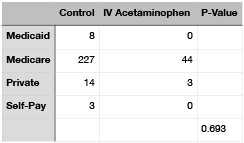
Analysis of the patient populations demonstrated no difference between the two groups regarding age, sex, race, or insurance status. Most patients were white and had Medicare insurance. (Table 1)

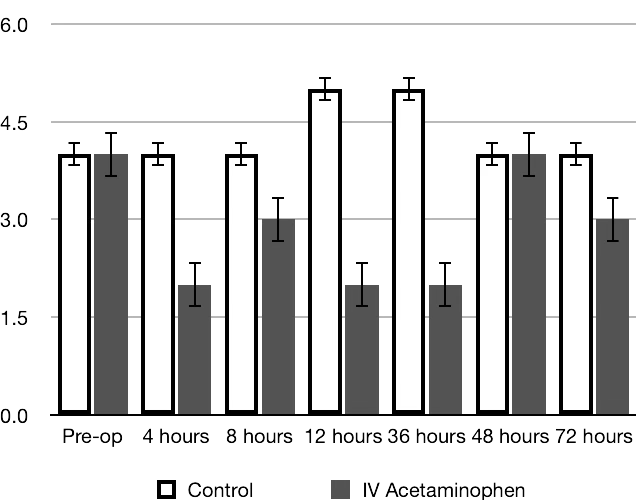
A statistically significant difference was found for median postoperative pain scores at 12, 36, and 72 hours in the IV Acetaminophen group. The median pain was 5.0 at 12 hours for control, compared to 2.0 for those given IV Acetaminophen (p=0.009). The median pain was 5.0 at 36 hours for control, compared to 2.0 for those given IV Acetaminophen (p < 0.001). The median pain was 4.0 at 72 hours for control, compared to 3.0 for those given IV Acetaminophen (p= 0.022). Although there was no statistically significant difference in pain score at 48 hours, we found that IV Acetaminophen was not inferior to the control group as pain scores were equivocal. (Graph 1).
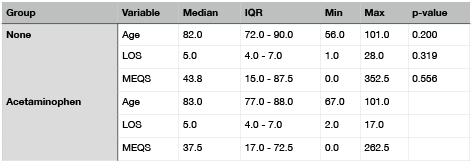
We found the median opiate MEQs trended towards a reduction for the IV Acetaminophen group (37.5 vs 43.8, p=0.556). However, this was not significantly different but may be clinically relevant. (Table 2) The median length of stay was unchanged between both groups with an average stay of 5 days.
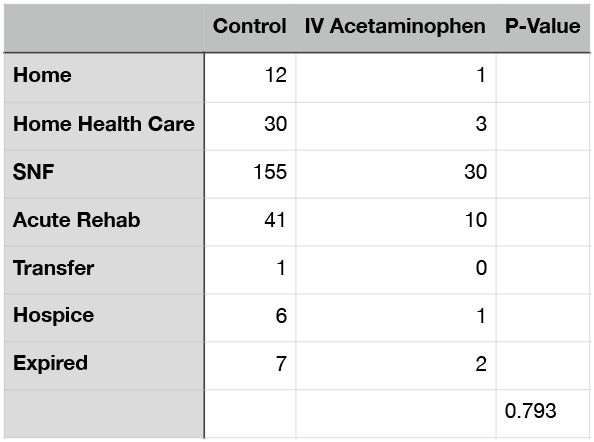
There was also no difference in insurance type and final disposition status between the two groups, with the majority of patients having Medicare and being discharged to a skilled nursing facility, respectively. (Tables 3, 4)
Discussion
Hip fractures are devastating and debilitating injuries with complex medical requirements. With approximately 2 million hip fractures worldwide each year they commonly require multi-disciplinary treatment. 1,2 Pre- and post-operative pain control can be difficult to manage in this particular aging population; opioids remain the mainstay treatment.2 Opiates have a well-documented side effect profile that may prove difficult to manage in the elderly patient, including delirium, respiratory depression, and gastrointestinal complaints. Acetaminophen is a widely used analgesic with a much safer side effect profile than that of opiates. Acetaminophen is also safe to administer through oral, rectal, and intravenous routes.3
Our quality improvement study demonstrated significant pain relief in the first 72 hours postoperatively in the treatment of geriatric hip fractures. These findings are consistent with current literature that favors IV acetaminophen with significantly lower pain scores and clinical implications as well. A study performed by Bollinger et al. performed a retrospective review of hip fracture patients who received IV acetaminophen and found a statistically significant shorter length of stay, decreased pain scores, lower narcotic usage, and fewer missed physical therapy sessions.2 Connolly et al. also noted similar findings in their study comparing IV and oral acetaminophen in hip fracture patients, which demonstrated a reduction in post-operative delirium, opioid use, readmission rates, and length of stay.5 Despite these promising findings, there is still some debate regarding the effectiveness of IV acetaminophen, especially when considering its mechanism of action and its effectiveness via differing routes.
The specific mechanism of action is currently not well known, although its analgesic effect largely comes from central inhibition of cyclooxygenase-2 isoenzymes (COX-2) in the brain. Studies have shown that IV administration leads to higher and more immediate peak levels. It is also understood that rectal administration bypasses the “first-pass” metabolism of the liver.3 A systematic review by Cho et al. found limited evidence that IV acetaminophen given to patients with hip fractures improved analgesia, reduced opioid consumption, reduced missed therapy visits, or decreased length of stay in the hospital.1 These findings may be the result of clinically but not statistically significant differences, as was demonstrated by our findings. Although the MEQ’s of opiates given during hospitalization was not statistically significant, there was still a trend towards the IV acetaminophen group.
There is scant data that directly compares outcomes regarding the length of stay when utilizing IV acetaminophen to oral, especially as it pertains to geriatric hip fractures. There is however much emerging data regarding elective orthopedic surgeries and pain management utilizing IV acetaminophen. A retrospective analysis by Barrington et al. demonstrated a decreased length of stay and decreased likelihood of being discharge to a skilled nursing facility (SNF) after elective total knee arthroplasty (TKA).6 A systematic review and meta-analysis of IV acetaminophen use after elective TKA also demonstrated a statistically significant decrease in hospital length of stay with utilization of IV acetaminophen.7 Often times, pain alone is not the primary reason for prolonged hospitalization after hip fractures. There are several other factors that could play a role as a possible explanation for the lack of statistically significant difference in length of stay for this study. Firstly, we did not account for medical co-morbidities or other injuries upon admission. Other factors include obstacles encountered in the disposition process, such as insurance pre-certification, or timing of surgery such as when surgery is performed on a weekend when it is not possible to initiate this process.
Further high-quality studies are essential to compare the outcomes of IV acetaminophen versus placebo in patients, employing a prospective blinded approach while controlling for compounding factors. Additionally, more research is needed to assess the efficacy of IV compared to oral acetaminophen in the postoperative setting for geriatric hip fractures. While our study focused on pain control, there may be other clinically significant benefits that warrant further exploration. Future investigations should also explore any statistical differences in side effects such as delirium and respiratory distress as these could provide clinically significant outcomes in the geriatric population.
Conclusion
In this quality improvement study, we found that a post operative pain regimen including IV acetaminophen was effective in managing pain in patients 55 and older with a femoral neck or intertrochanteric hip fractures. Post-operative pain was better controlled for the first 72 hours with a trend towards decreased opiate consumption in the hospital. As a result of these findings, the hospital instituted a new policy that included IV acetaminophen as a standard of care for geriatric hip fractures. Future research investigating the effect this has on rehabilitation, length of stay, delirium, and other theoretical benefits are needed to further identify practical outcomes in pain management for this population.
References
- Cho JSH, McCarthy K, Schiavo S, et al. Effect of intravenous acetaminophen on postoperative outcomes in hip fracture patients: a systematic review and narrative synthesis. Can J Anaesth. Jul 2022;69(7):885-897.
- Bollinger AJ, Butler PD, Nies MS, Sietsema DL, Jones CB, Endres TJ. Is Scheduled Intravenous Acetaminophen Effective in the Pain Management Protocol of Geriatric Hip Fractures? Geriatr Orthop Surg Rehabil. Sep 2015;6(3):202-8. doi:10.1177/2151458515588560
- Gerriets V AJ, Patel P, et al . Acetaminophen. [Updated 2024 Jan 11]. StatPearls [Internet]. Treasure Island (FL): StatPearls Publishing; 2025 Jan
- Tompkins DM, DiPasquale A, Segovia M, Cohn SM. Review of Intravenous Acetaminophen for Analgesia in the Postoperative Setting. Am Surg. Nov 2021;87(11):1809-1822. doi:10.1177/0003134821989056
- Connolly KP, Kleinman RS, Stevenson KL, Neuman MD, Mehta SN. Delirium Reduced With Intravenous Acetaminophen in Geriatric Hip Fracture Patients. J Am Acad Orthop Surg. Apr 15 2020;28(8):325-331. doi:10.5435/jaaos-d-17-00925
- Barrington JW, Hansen RN, Lovelace B, et al. Impact of Intravenous Acetaminophen on Lengths of Stay and Discharge Status after Total Knee Arthroplasty. J Knee Surg. 2019;32(1):111-116. doi:10.1055/s-0038-1636908
- Teng Y, Zhang Y, Li B. Intravenous versus oral acetaminophen as an adjunct on pain and recovery after total knee arthroplasty: A systematic review and meta-analysis. Medicine (Baltimore). 2020;99(50):e23515. doi:10.1097/MD.0000000000023515