Brandon D. Rust, OMS41; Christopher L. Rennie, DO2; Ambika Singh, OMS31; Matthew McKinley, OMS31; Graham Girdler, OMS31; Leighann C. Krasney, DO, MPH3
1Nova Southeastern University Dr. Kiran C. Patel College of Osteopathic Medicine
2Philadelphia College of Osteopathic Medicine
3Mountain Valley Orthopedics
DOI: http://doi.org/10.70709/jzcn6qui
ABSTRACT
Background
Peer-reviewed publications authored by Doctors of Osteopathic Medicine (D.O.) in the orthopaedic literature have traditionally been sparse. Considering the increasingly competitive nature of orthopaedic shoulder and elbow (S&E) surgery fellowships, active involvement in research is one of the various factors highly valued amongst applicants. In this study, we aimed to evaluate the current trends in the contribution of osteopathic physicians to orthopaedic literature and assess it potential impact on prospective candidates seeking placement into the orthopaedic S&E fellowship programs.
Methods
Using the Clarivate Analytics database, the top ten orthopaedic surgery journals were identified using their 2022 impact factor (IF) that reflected a minimum of 8% coverage of S&E orthopaedic topics. Articles published between 2017 and 2024 were screened to identify publications authored by a D.O. and their authorship position. Trends in D.O. publications were compared to assess the correlation between publication trends and SF match data utilizing the San Francisco Residency and Fellowship Match Services (SF Match) data from 2017-2024.
Results
Between 2017 and 2024, the D.O. authorship rates ranged from 0.17% to 4.70%, with an overall publication rate of 1.78% (N=386). In this timeframe, there was a significant increase in D.O. publication rates in the orthopaedic and S&E literature (P =0.003). There was no significant increase in the number of D.O. first or senior author positions over the study period (P=0.07 and P=0.26, respectively). However, there was a strong correlation between the increase in publications with a D.O. author and the increase in D.O. first authorship (r=0.89). Osteopathic S&E fellows comprised 4.76%-20.00% of all S&E fellows per year, with an average of 11.77% ± 5.55% from to 2017-2024. Match rates for osteopathic applicants in S&E fellowships ranged from 66.67% to-100% with an average match rate of 82.6%. Temporally, there was a decreasing trend in osteopathic match rate in the S&E fellowship; however, this was not statistically significant (P=0.16). However, the proportion of S&E fellows who are D.O.’s has decreased significantly (P=0.019). Additionally, there was a significant negative correlation between the proportion of D.O.’s in S&E fellowships and D.O. publication rates (r=0.82, P=0.013).
Conclusion
Although D.O. orthopaedic surgeons comprised approximately 12% of S&E fellowship positions, only 1.8 of every 100 publications had a D.O. author. While there is a confirmed disparity in D.O. authorship in the orthopaedic literature, D.O. publication rates have increased over time. However, the proportion of D.O.’s in S&E fellowships has significantly decreased throughout the same timeframe, which is contrary to the current literature on other orthopaedic subspecialties. This investigation suggests that although osteopathic orthopeaedists have increased their authorship in S&E literature, this growth may not be sufficient to keep pace with their allopathic counterparts. Our results indicate that for osteopathic orthopaedic surgeons, successful matching into an S&E fellowship is likely influenced by additional factors beyond scholarly publications alone.
Keywords: Shoulder and Elbow, Shoulder and Elbow Fellowship, Orthopaedic Surgery, Fellowship, Osteopathic Medicine, Publication Rates
INTRODUCTION
Since the inception of Osteopathic Medicine and the establishment of the Doctor of Osteopathic Medicine (D.O.), the practice has been underrepresented in the medical field. As of 2024, there are nearly four times as many allopathic schools (157) as osteopathic schools (42) throughout the United States (U.S.) (1,2). Osteopathic medical students represent 25% of all medical students nationwide, although only 11% of all physicians in the U.S. have osteopathic medical education (3). This imbalance extends into the field of orthopaedic surgery. In 2022, the Association of American Medical Colleges (AAMC) reported in the U.S. Physician Workforce Data Dashboard that out of 19,291 practicing orthopaedic surgeons, only 1,196 were osteopathic physicians (6.2%) (4). This gap is also evident in fellowship training, with the majority (> 90%) of graduating orthopaedic residents applying for subspecialty fellowships with allopathic education(5, 6).
Fellowship selection is highly competitive. In the 2024 match cycle, the Shoulder and Elbow (S&E) fellowship had the second-lowest vacancies, filling approximately 93.5% of the available seats. Specifically, there were 82 applicants for 46 positions, with 43 positions filled, including 3 by osteopathic applicants (5,6). USMLE scores and AOA membership have been found to correlate with an increased number of S&E interview invitations; however, a key aspect of strong candidacy is active participation in authoring peer-reviewed publications, which is highly regarded by orthopaedic fellowship directors(7,8). Research and scholarly activities have become commonplace and are mandated by the Accreditation Council for Graduate Medical Education (ACGME) for all medical trainees in accredited residency programs.
The impact of research and authorship on fellowship match rateshav been extensively examined in nearly all subspecialties within orthopaedic surgery (9-15). However, there remains a gap in the literature regarding the extent to which D.O. trainees publish in orthopaedic journals and their influence on successfully matching into S&E fellowships. This study aims to assess the progression of orthopaedic and S&E-related publications with D.O. authors in the literature and detect correlations between these trends and osteopathic S&E fellowship placements.
MATERIAL AND METHODS
This study was exempt from institutional review board approval. Using the Clarivate Analytics database, a systematic review of scientific journals has identified 157 patients specific to orthopaedic surgery. These journals were filtered to exclude those that lacked consistent coverage of S&E-related publications. In this study, consistent coverage was defined as a minimum of 8% of the total number of publications. The top 10 orthopaedic surgery journals were then selected for comprehensive analysis based on their 2022 Journal Impact Factor (IF) (Figure 1).
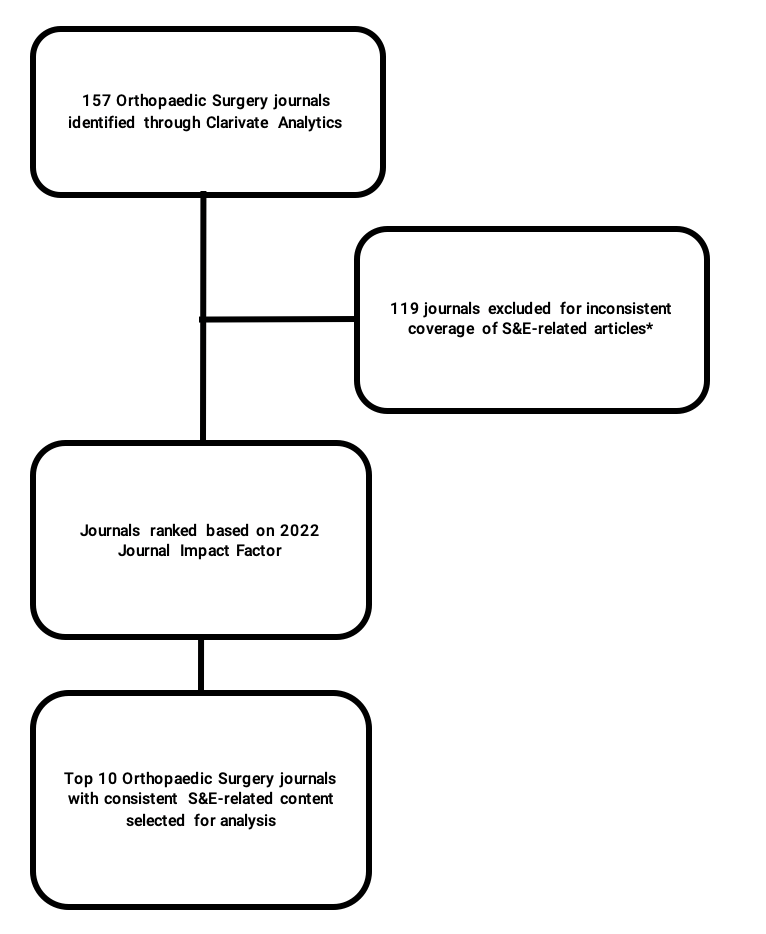
*Orthopaedic S&E topics within journal article titles from 2017-2024 were quantified and compared to total publications, with consistent coverage defined as at least 8% of total publications during this period.
All articles from 2017 to 2024 were screened to identify publications authored by D.O. as well as their authorship positions. Manual data collection for each of the 10 journals was performed by five authors (B.D.R, C.L.R., A.S., M.M., and G.G.), and the compiled data were recorded and organized in an Excel spreadsheet.
The D.O. degree of each author was identified using the PDF version of the publication. When the medical degree or credentialing was not explicitly stated, a targeted internet search was conducted for verification based on the author’s location and affiliated institution. Osteopathic authors were further classified by their authorship order (i.e., first, middle, or senior) along with documentation of whether the article was relevant to the subject of S&E surgery. The number of articles with an osteopathic author was calculated for each year across all journals, and articles with multiple osteopathic authors were treated as single publications. Trends in D.O. author publications and authorship positions were analyzed from 2017 to 2024, with a focus on first and senior authorship positions due to the typically more assistive role of middle authors in research projects (7).
Data from the San Francisco Residency and Fellowship Match Services (SF Match) were reviewed to assess match rates of osteopathic applicants from 2017-2024, the first year S&E fellowship was included as a subspecialty within the matching service. Each year, the number of allopathic and osteopathic trained applicants and their corresponding match rates are reported. Trends in D.O. publications and osteopathic S&E fellowship match rates were then analyzed for potential correlations.
Statistical Analysis
All statistical analyses, including two-sample paired T-tests and simple linear regressions, were performed using RStudio 2022.02.0 (RStudio Team, RStudio: Integrated Development for R. RStudio, PBC, Boston, MA). A linear regression model with confidence intervals was computed. Pearson correlation coefficients were used to assess the linear relationships between time (in years) and variables such as publications, authorship positions, fellowship applications, and match rates. A moderate correlation strength was defined as a Pearson correlation coefficient (r) of 0.5-0.69, with a strong correlation set for an r>0.7. Statistical significance was set for a P <0.05.
RESULTS
Between 2017 and 2024, 21,648 articles were reviewed from the top 10 orthopaedic surgery journals, excluding abstracts, letters to editors, author responses, introductions, commentaries, and symposia (Table 1).

*Obtained from Clarivate Analytics 2022 Journal Impact Factor Report
+The British Editorial Society of Bone & Joint Surgery disseminates scholarly work through its publications: The Bone & Joint Journal, Bone & Joint Research, and Bone & Joint Open. These journals are individually indexed within Clarivate’s Web of Science database. Despite their separate indexing, due to their consistently high Impact Factor rankings, articles from these journals are aggregated under a single ranking.
The publication rates for D.O. authors in the orthopaedic S&E literature ranged from 0.17% to 4.70%, with an overall rate of 1.78% (N=386). A significant increase in DO authorship was observed over time (P=0.003), with a low of 0.91% in 2017, peaking at 2.58% in 2024 (Figure 2).

The percentage of D.O. first authors in the surveyed journal articles remained above 0.66% after 2018, peaking at 1.01% in 2020, whereas D.O. senior authorship remained below 0.5% during this period (Figure 3).
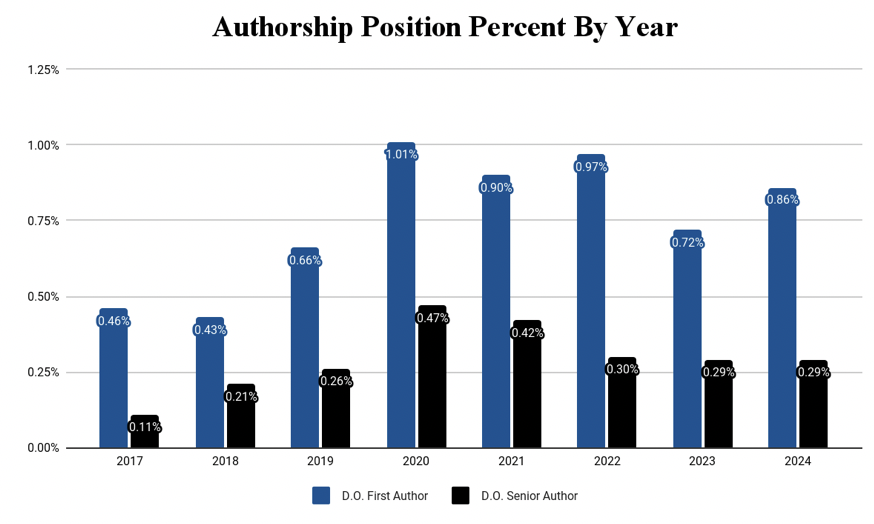
No significant increase was observed in the D.O. first or senior author positions (P=0.07, P=0.26).
A strong correlation was observed between the increase in D.O. S&E publications and D.O. first authorship (r = 0.89). Similarly, a strong correlation was observed between the growth in D.O. S&E publications and D.O. senior authorship (r=0.78) (Table 2).

S&E, shoulder and elbow
An analysis assessing the correlation between the D.O. publication rate and S&E match rate over time revealed a weak correlation over the study period (r=0.44).
The SF match rates for osteopathic applicants to S&E fellowships ranged from 66.67% to 100%, with an average of 82.6%, over the study period (Table 3).
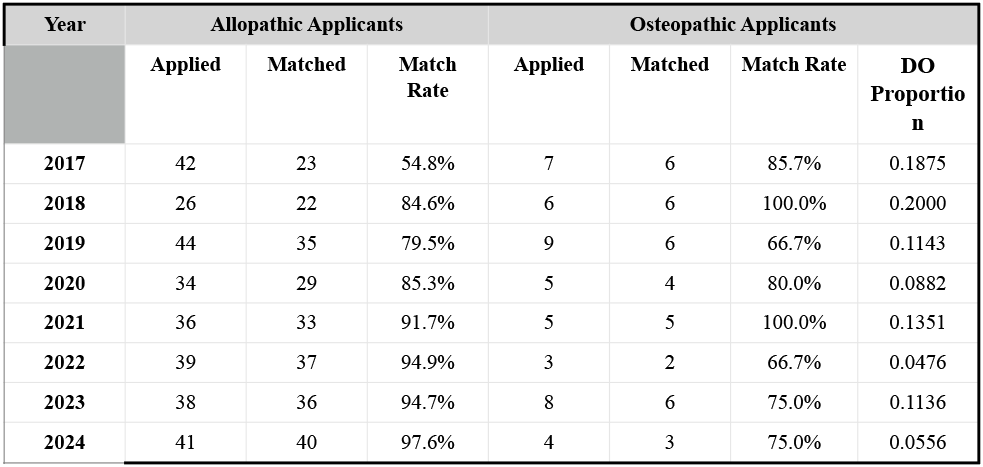
After achieving an 85.7% and 100% match rate in 2017 and 2018, respectively, a decline was noted in 2019 (66.67%) and 2020 (80%), although this trend was not statistically significant (P=0.16). Osteopathic fellows comprise 4.76% to 20.00% of all S&E fellows annually, with an average of 11.77% ± 5.55% from 2017-2024. However, the proportion of D.O.s relative to M.D.s in S&E fellowships significantly decreased over this period (P=0.019). Additionally, a significant negative correlation was found between the decreasing proportion of D.O.s in S&E fellowships and increasing D.O. publication rates (r=0.82, P=0.013).
DISCUSSION
Orthopaedic surgical fellowships commonly view research and authorship in publications as essential factors when considering an applicant’s position. Our study demonstrated a marked increase in D.O. authorship in the orthopaedic S&E literature from 2017 to 2024. This trend reflects the growing representation of osteopathic physicians in orthopaedic research, particularly in the subspecialty of S&E.
Despite a statistically significant increase in osteopathic authorship in prominent orthopaedic journals, the proportion of osteopathic acceptance in S&E fellowships significantly declined over the study period. This suggests that although osteopathic orthopeaedists have increased their authorship in S&E literature, this growth may not be sufficient to keep pace with their allopathic counterparts. Moreover,we found only a weak correlation between the total D.O. publication rate and the D.O. match rate for the S&E fellowships. Conversely, a recent study by Albana et al. reported that increased scholarly output among osteopathic physicians in the hip and knee arthroplasty literature was positively correlated with higher match rates in orthopaedic adult reconstruction fellowships, demonstrating a strong positive relationship between total osteopathic publications and success of matching into fellowship(7).
While overall D.O. authorship has increased, representation in first and senior author roles remains limited, with only modest growth over time. These authorship positions, often held by residents and attending surgeons, are key indicators of research leadership and correlate with match outcomes (16). Our findings reveal a positive correlation between the rise in D.O. publications and increased presence in these roles, indicating growing, yet still constrained, academic involvement. This trend aligns with prior work by Albana et al., who reported similar associations in arthroplasty literature (7). Continued efforts to strengthen mentorship and support are needed to further advance osteopathic participation in lead authorship, particularly within S&E research.
Current literature indicates that the number and quality of publications are crucial factors for matching into surgical specialties for residency (17). Additionally, growing evidence suggests that more publications in high-impact journals are associated with successful fellowship matches. Fares et al. reported an increasing trend in total publications, high-impact journal publications, and first-author publications among applicants who successfully matched into orthopaedic S&E fellowships from 2010 to 2019 (15). Similarly, Carr et al. found that residents pursuing orthopaedic surgery fellowships had significantly more peer-reviewed publications compared to those not pursuing fellowships (5.9 vs. 1.5 publications) (8). Both studies indicated an increase in publications among orthopaedic residents pursuing fellowship, although they did not clearly differentiate such trends between osteopathic and allopathic candidates. The numerical dominance of allopathic candidates may account for the decline in osteopathic match rates for S&E fellowships, despite the growth in both the volume and quality of osteopathic authorship.
A significant negative correlation was observed between D.O. publication rates and representation in S&E fellowships, suggesting that increased research output does not necessarily translate to improved match outcomes. This may reflect disparities in pre-residency research experience, as allopathic applicants generally enter residency with stronger research backgrounds (18-21). Such differences may persist through residency, influencing the ability to lead impactful projects and build impactful collaborative networks. This study has several limitations that should be considered when interpreting the findings. First, manual data collection did not differentiate between osteopathic residents and attending physicians, as training levels are not typically indicated in orthopaedic literature. The reliance on the Clarivate Analytics database and the specific journal selection criteria may have excluded relevant publications, potentially leading to an incomplete representation of D.O. authorship. Furthermore, the analysis focused on a limited number of journals, which may not fully capture the extent of osteopathic contributions, particularly in less prominent orthopaedic journals.
CONCLUSION
Although D.O. orthopaedic surgeons comprised approximately 12% of S&E fellowship positions, only 1.8 of every 100 publications had a D.O. author. While there is a confirmed disparity in D.O. authorship in the orthopaedic literature, D.O. publication rates have increased over time. However, the proportion of D.O.’s in S&E fellowships has significantly decreased throughout the same timeframe, which is contrary to the current literature on other orthopaedic subspecialties. This investigation suggests that although osteopathic orthopeaedists have increased their authorship in S&E literature, this growth may not be sufficient to keep pace with their allopathic counterparts. Our results indicate that for osteopathic orthopaedic surgeons, successfully matching into an S&E fellowship is likely influenced by additional factors beyond scholarly publications alone.
Acknowledgments
The authors would like to acknowledge the following contributors for their support in the research process:
- Jashkumar Chaudhari, OMS-IV, for contributions to data collection and analysis.
- Brendan Chernicki, DO, for contributions to data collection and data interpretation.
References
- U.S. Colleges of Osteopathic Medicine, in: American Association of Colleges of Osteopathic Medicine, 2024.
- Accredited MD Programs in the United States, in: Liaison Committee on Medical Education, 2024.
- Quick facts 2023, in: American Association of Colleges of Osteopathic Medicine.
- Colleges AoAM: U.S. Physician Workforce Data Dashboard, in, 2022.
- Orthopaedics Fellowship Match Report, in: San Francisco Residency and Fellowship Match Services, 2024.
- Silvestre J, Nelson CL, Thompson TL, Kang JD: Trends in ACGME Accreditation of Orthopedic Surgery Fellowship Training. Orthopedics 2024;47:57-63. DOI: 10.3928/01477447-20230426-06
- Albana MF, Bianco LD, Walsh JW, Henken-Siefken A, Wu ES: Trends in Osteopathic Authorship in Orthopedic Publications and Its Impact on Adult Reconstruction Match Rates. Arthroplast Today 2023;24:101276. DOI: 10.1016/j.artd.2023.101276
- Carr M, Anderson JM, Shepard S, et al.: An analysis of publication trends of orthopedic surgery residency graduates in relation to academic achievement. J Osteopath Med 2022;122:195-202. DOI: 10.1515/jom-2021-0196
- Benes G, ElNemer W, Avendano J, Hsu N, Aiyer A: Research Productivity and Impact in Foot and Ankle Surgery: Insights From Relative Citation Ratio Analysis of Recent Fellowship Graduates. J Am Acad Orthop Surg Glob Res Rev 2024;8. DOI: 10.5435/JAAOSGlobal-D-23-00280
- Lambrechts MJ, Heard JC, Lee YA, et al.: Predictors of Academic Productivity Among Spine Surgeons. J Am Acad Orthop Surg 2023;31:505-510. DOI: 10.5435/jaaos-d-22-01011
- Silvestre J, Chang B, Wilson RH: Charting Outcomes in the Hand Surgery Fellowship Match. J Hand Surg Am 2024;49:280.e281-280.e286. DOI: 10.1016/j.jhsa.2022.07.009
- Clark SC, Sanborn L, Brown SM, Trojan JD, Mulcahey MK: Research Productivity of Orthopaedic Sports Medicine Fellowship Programs in the United States. Arthrosc Sports Med Rehabil 2021;3:e997-e1002. DOI: 10.1016/j.asmr.2021.02.007
- Shaath MK, Warner SJ, Kellam JF, Achor TS: The Competitive Orthopaedic Trauma Fellowship Applicant: A Program Director’s Perspective. J Am Acad Orthop Surg Glob Res Rev 2021;5. DOI: 10.5435/JAAOSGlobal-D-20-00175
- Khan AZ, Kelley BV, Patel AD, McAllister DR, Leong NL: Academic productivity among fellowship associated adult total joint reconstruction surgeons. Arthroplast Today 2017;3:298-302. DOI: 10.1016/j.artd.2017.05.007
- Fares AB, Carter JT, Chan AG, Khalifa R, Kilcoyne KG, Weiss WM: Publication Trends of Residents Accepted for Shoulder and Elbow Fellowships. J Surg Orthop Adv 2022;31:205-208.
- Riesenberg D, Lundberg GD: The order of authorship: who’s on first? JAMA 1990;264:1857.
- Patel H, Wright DD, Hernandez N, et al.: Evaluating the Factors Influencing Residency Match for Surgical Specialty Applicants and Programs: Challenges and Future Directions. Am Surg 2024:31348241262427. DOI: 10.1177/00031348241262427
- Wood RS, Krumrey J: Examining differences in trends in the orthopedic surgery match for osteopathic and allopathic medical graduates after the transition to single accreditation. J Osteopath Med 2024;124:291-297. DOI: 10.1515/jom-2023-0240
- Matthews CN, Estrada DC, George-Weinstein M, Claeson KM, Roberts MB: Evaluating the Influence of Research on Match Success for Osteopathic and Allopathic Applicants to Residency Programs. 2019;119:588-596. DOI:10.7556/jaoa.2019.102
- Tvedten EJ, Turnbull JP, Guo W, Motaparthi K: Attitudes toward allopathic and osteopathic candidates in the dermatologic residency application process. Clin Dermatol 2023;41:178-186. DOI: 10.1016/j.clindermatol.2022.10.002
- Ho A, Auerbach A, Faulkner JJ, Guru SK, Lee A, Manna D: Barriers to research opportunities among osteopathic medical students. 2023;123:187-194. DOI:10.1515/jom-2022-0116