
Marielle De Baun, OMS IV1; Jonathan Irby, MS, OMS IV1; Chris Walsh, OMS IV1; Megan Wijesinghe, OMS IV1; Gabrielle Costain, OMS IV1; Dr. Daryll Auston, MD, PhD2.
1Rocky Vista University College of Medicine
2Lutheran Medical Center, Orthopedic Trauma Department
DOI: http://doi.org/10.70709/tsx7v2t
Abstract
Background
U-shaped sacral insufficiency fractures represent a unique subset of fragility fractures that cause severe pain, instability, and loss of mobility in elderly osteoporotic patients. Their diagnosis is challenging, and management remains controversial, with limited consensus on surgical management. This narrative review explores the major interventions available for U-shaped sacral insufficiency fractures.
Methods
We conducted a narrative review of 45 studies published between 2000-2024 evaluating outcomes of conservative treatment versus surgical stabilization techniques, including sacroplasty, percutaneous screw fixation, and lumbopelvic fixation.
Results
Across the literature, surgical fixation was consistently associated with faster pain reduction, earlier mobilization, and lower rates of immobility-related complications compared with nonoperative care. Percutaneous screw fixation provided significant improvements in pain and function, though loosening rates reached 20% in severely osteoporotic bone. Lumbopelvic fixation offered the greatest biomechanical stability for highly unstable fractures but carried higher surgical morbidity. Evidence remains largely from small retrospective series, with limited long-term follow-up.
Conclusion
Early surgical stabilization appears to improve short-term outcomes in U-shaped sacral insufficiency fractures, though risks of surgical complications remain. Larger prospective studies are needed to define optimal patient selection and standardize treatment pathways.
Keywords: U-shaped sacral fractures, sacral insufficiency fractures, sacral fragility fractures, osteoporosis
Introduction
Sacral insufficiency fractures are an uncommon but increasingly recognized cause of debilitating low back, gluteal, and pelvic pain in elderly patients with osteoporosis or other metabolic bone disorders. Unlike the high-energy spinopelvic dissociations seen in younger trauma patients, these insufficiency fractures occur with minimal to no trauma and reflect structural weakness of osteoporotic bone 1. Among the various types of sacral insufficiency fractures, U-shaped sacral fractures stand out due to their distinct fracture pattern and their tendency to cause severe pain, instability, and functional impairment 2. Diagnosis is often delayed due to a nonspecific presentation mimicking more benign causes of back pain and a low sensitivity of plain radiographs 3. Management strategies range from nonoperative treatment with protected weight bearing to surgical stabilization with sacroplasty, percutaneous screws, or lumbopelvic fixation, but there is little consensus on optimal care 2. This review synthesizes the existing evidence to clarify diagnosis, management strategies, and outcomes for sacral insufficiency U-shaped insufficiency fractures.
Methods
A targeted search was conducted to collect existing literature on U-shaped sacral insufficiency fractures. The databases PubMed and Embase were searched using a combination of relevant Medical Subject Headings (MeSH) and free-text terms. The search strategy included the following terms: “iliosacral fixation,” “bone screws,” “fracture fixation, internal,” “conservative treatment,” “conservative therapy,” “conservative management,” “sacrum,” “sacral vertebrae,” “stress fracture,” “insufficiency fracture,” and “osteoporotic fracture.”
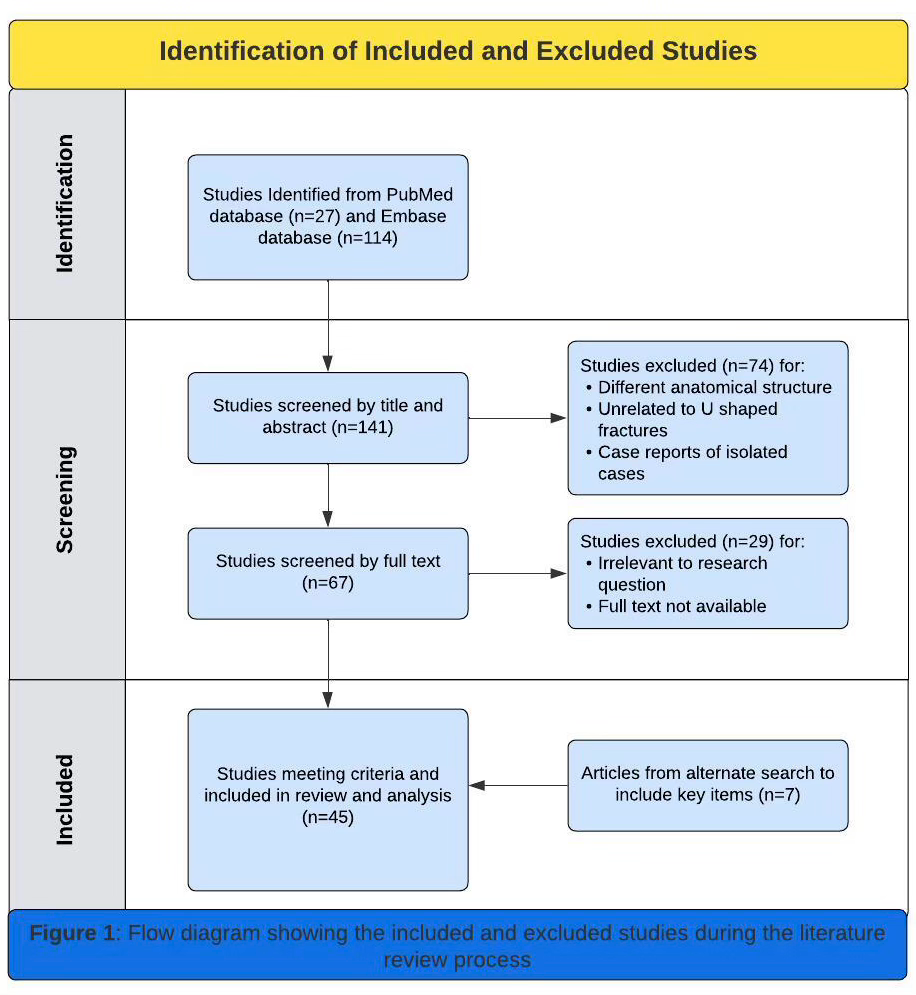
To ensure relevance, studies were selected based on predefined inclusion and exclusion criteria. Eligible publications were peer-reviewed articles in English, published between 2000 and 2024, with a focus on sacral fractures, preferably with U-shaped patterns. Outcomes of interest included fracture healing time, functional recovery, complication rates, and mortality. Articles were further required to report comparative outcomes between treatment modalities (e.g., conservative vs. operative) and/or to evaluate minimally invasive surgical techniques or other innovative approaches to sacral fracture stabilization.
Articles published prior to 2000, non-English articles, abstracts, and editorials were excluded from this review. Additionally, studies were excluded if they focused on anatomical regions other than the sacrum, such as lumbar or thoracolumbar fractures, or if they examined fractures unrelated to U-shaped sacral fractures, including pathological fractures or those caused by rare conditions.
The search of PubMed yielded 27 articles, while the search of Embase returned 114 articles. After applying the pre-defined inclusion and exclusion criteria, a total of 45 articles were deemed applicable and included in the final review. The major findings are summarized below.
Anatomy of the Sacrum and Mechanism of U-Shaped Fractures
The sacrum forms the base of the spine and the posterior portion of the pelvis, with ossification completed between the ages of 25 and 33 1. The sacrum is integral to force distribution through its iliac articulation bilaterally to complete the pelvis, and lumbar spine articulation superiorly 1. In weight-bearing activities, the sacrum mediates caudal and rostral forces between the upper body and lower extremities through the spine and pelvis, respectively 1.
Considering the biomechanical forces passing through the sacrum, fragility fractures can develop without preceding traumatic events. In osteoporotic bone, relatively minor forces can initiate vertical fractures in the sacral alae, areas of inherent structural vulnerability 4. Three-dimensional reconstruction of computed tomography (3D CT) models of the sacrum suggest that the paraforaminal area and S2 vertebra have naturally lower bone mass, potentially predisposing this population to fragility fractures of the sacrum 2.
Another clinically relevant mechanism of sacral fracture involves preceding degenerative spinal pathology such as L5-S1 spondylolisthesis 5. Progressive anterior translation at L5-S1 increases anterior shear forces and results in repetitive microtrauma at the sacrum, particularly in osteoporotic bone 5. Recognition of this pathophysiology is important, as exacerbation of back pain in patients with known spondylolisthesis may be attributed to the spinal pathology rather than a new sacral insufficiency fracture 6.
Additionally, sacral insufficiency fractures can be caused by rigid constructs, such as prior spinal fusion and advanced spondylosis 7. Stiffness of the spine increases load transfer to the sacrum and peri-implant area, which has decreased ability to distribute forces in the setting of osteoporosis 8. This combination of rigid instrumentation, reduced motion, and osteoporotic bone results in elevated shear and compressive forces at the sacrum, with eventual manifestation of insufficiency fractures 7-10.
A specific type of insufficiency fracture, referred to as U-shaped sacral fractures, is characterized by bilateral vertical fracture lines through the sacral alae. Stress on the horizontal bony bridges between the sacral foramina, typically between the S1 and S3 foramina, culminates in a bridging transverse fracture to complete the U shape4–6 . Spinopelvic dissociation, foraminal impingement of sacral nerve roots, and cauda equina syndrome are then free to occur from the lost stability of U-shaped fractures 11-14.
Rising Prevalence of U-shaped Sacral Insufficiency Fractures
U-shaped sacral insufficiency fractures are increasingly recognized as a distinct subset of sacral insufficiency fractures that primarily affect elderly, osteoporotic populations. Specifically, U-shaped insufficiency fractures may account for up to 16.7% of sacral insufficiency fractures in geriatric patients 15. The rising prevalence is likely attributable to longer life expectancies, increased survival of patients with osteoporosis, and improved detection 15-17. Risk factors include advanced age, osteoporosis, obesity, and in rare cases, adjacent lumbosacral fusions 16,17.
Historically, it has been estimated that nearly half of all sacral fractures were missed, particularly if there were concomitant pelvic fractures 18. Advanced imaging, such as CT and MRI, can identify complex fracture patterns that were previously underdiagnosed with radiography 19. However, delayed diagnosis is common due to nonspecific symptoms and a low index of suspicion, leading to investigation with solely plain radiographs 2,20. The projected growth of the elderly population, coupled with the increasing incidence of U-shaped sacral insufficiency fractures and other fragility fractures, is projected to place a significant strain on healthcare resources and increase associated costs 2,20.
Presentation and Diagnosis of U-Shaped Sacral Insufficiency Fractures
Diagnosis of U-shaped sacral insufficiency fractures is challenging due to its nonspecific clinical presentation, chronicity, and subtleties on imaging 21. Patients often present without antecedent trauma, complaining of progressive low back, gluteal, or pelvic pain. As such, there is frequent misattribution to lumbar spine or degenerative pathologies 2,22. The lack of familiarity with or suspicion for sacral insufficiency fractures results in inappropriate initial imaging and delays in diagnosis 22. Patients presenting to the emergency department may experience delays on average of greater than 3 weeks from time of initial presentation to final diagnosis 22.
Plain X-rays, often the first imaging modality used, lack the sensitivity to detect U-shaped sacral fractures. Sensitivities of radiographic detection have been estimated to be as low as 10-28.5% 19,23. The anteroposterior view of pelvic radiographs can fail to capture the angulation of sacral insufficiency fractures, and the curvature and anatomy of the sacrum, combined with overlapping structures such as bowel gas and fecal material, can further obscure fracture lines 24. The American College of Radiology recommends using MRI or CT when sacral insufficiency fractures are suspected, as they have greater sensitivity for detecting fracture lines 25.
Advanced imaging modalities such as MRI and CT are essential for accurate diagnosis. MRI demonstrates near-complete sensitivity, detecting both fracture lines and associated bone marrow edema, and is superior in identifying complex patterns such as U-shaped or H-type fractures, which may be missed or underestimated on CT 26. Likewise, MRI can exclude alternative causes of pelvic pain 26. When a sacral fracture is suspected due to trauma, CT remains valuable for characterizing fracture morphology and excluding alternative diagnoses, but MRI is preferred for early detection and for distinguishing insufficiency fractures from spinal, neoplastic, or infectious processes 26,27.
Conservative Management of Sacral Insufficiency Fractures
Conservative treatment is typically indicated for non-displaced or minimally displaced fractures or in patients who cannot otherwise tolerate surgery 2,20,28. Successful conservative management is more likely when satisfactory pain control is achieved to allow for early mobilization and participation in rehabilitation 2,20. Early and effective pain management is essential for facilitating mobilization and preventing the cycle of pain, immobility, muscle weakness, and subsequently further pain. A multimodal approach, combining pharmacological and non-pharmacological pain management strategies, is emphasized in the literature for achieving better outcomes 2,15–17. The sources recommend periodic imaging during conservative management to monitor for changes in the fracture 17.
Several factors influence the long-term outcomes of conservative treatment, including the characteristics of the fracture itself. Complex, displaced, or otherwise unstable fractures, including U-shaped fractures, are more likely to result in non-union if managed conservatively 15,20,29. Prolonged immobilization can occur, leading to the development of chronic pain and slower functional recovery 15,20. In a study using the modified Barthel Index (HBI), patients treated conservatively with initial pain levels above 5 on a visual analog scale experienced delayed pain reduction and only moderate improvement in self-reliance 30.
While conservative treatment is a valid initial strategy, careful assessment of fracture stability, patient-specific factors, and close monitoring are crucial. If conservative measures fail to provide adequate pain relief, allow for timely mobilization, there is new or worsening neurologic symptoms, or if the fracture progresses, surgical intervention may be necessary.
Surgical Interventions for Sacral Insufficiency Fractures
Selection of the appropriate surgical technique is guided by fracture morphology based on CT or MRI, degree of instability, patient comorbidities, and functional status 20. Additionally, consideration should be given to correct the underlying cause, such as creation of a rigid and immobile segment by prior spinal fusion or pre-existing spondylolisthesis 6-8. Because U-shaped sacral insufficiency fractures represent a spectrum of instability, treatment strategies must be individualized, ranging from minimally invasive techniques to more extensive spinopelvic fixation. Comparisons between non-operative vs operative management have concluded that surgical treatment enables earlier mobility and pain relief, factors that influence morbidity and mortality 28,31,32. In the following sections, the major surgical options are outlined and categorized, with discussion of their indications, technical considerations, and reported outcomes.
Sacroplasty
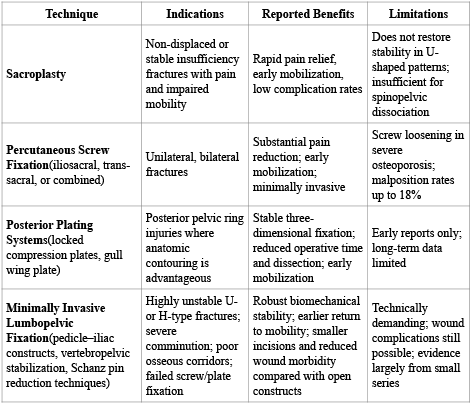
Sacroplasty is widely used for pain control in stable and non-displaced fractures 33. By injecting polymethylmethacrylate cement into the sacrum, rapid pain relief and early mobilization can be achieved, particularly in frail osteoporotic patients 33,34. However, while sacroplasty is effective in restoring function in simple insufficiency fractures, it is limited in the context of U-shaped patterns 35. Finite element models and early clinical data suggest that cement augmentation alone may be insufficient to re-establish physiologic weight-bearing capacity of the sacrum 35. For this reason, sacroplasty is best considered as an adjunct for analgesia rather than a stabilizing treatment for unstable fractures 33-35.
Percutaneous Screw Fixation
Percutaneous screw fixation provides a reliable method to stabilize the posterior pelvic ring with minimally invasive access under fluoroscopic or CT guidance 4,32,35-37. Techniques primarily include trans-sacral and ilio-sacral screws, each with unique indications and limitations 35-38. In comparative analyses, patients stabilized with percutaneous screws demonstrated significant pain reduction, regained mobility earlier, and had shorter hospital stays than those treated conservatively 38.
Trans-sacral Screws
Trans-sacral screws span across the sacrum, often at the S1 or S2 level for fixation through both sacral alae 39,40. This construct provides enhanced stability, particularly in bilateral and unstable fracture patterns due to its ability to resist rotational and shear forces across the sacrum 39-40. Clinical studies report earlier mobilization and faster discharge rates, though screw loosening is a concern with up to a 20% rate of loosening 39-42. As a result, cement augmentation has been proposed as the standard of care for its ability to reduce screw loosening and provide sustained pain relief up to one year postoperatively 21,29,39-43. Regardless, augmentation may not be enough to overcome severe osteoporosis and comminution, and narrow osseous corridors can limit screw placement in some patients 4,32,39-43.
Ilio-sacral Screws
In contrast to trans-sacral screws, ilio-sacral (trans-iliac) screws traverse the sacroiliac joint to anchor the sacrum and ilium 44. They are most used in unilateral and lower complexity fracture patterns, where full trans-sacral stabilization may not be required 44. As a result, faster operative times and time to mobilization make this an appealing option for patients 44. Ilio-sacral fixation provides pain reduction and functional recovery, but carries a higher risk of malposition, with reported rates up to 18% even among experienced surgeons 40,45,46. While cement augmentation can improve durability and positioning, failure can still occur in highly comminuted and osteoporotic bone 45,46. In U-shaped fractures, ilio-sacral fixation may not be robust enough nor provide reliable enough positioning, necessitating the need for lumbopelvic fixation 44,47,48.
Lumbopelvic Fixation
Traditional open lumbopelvic fixation provides robust stability for U- and H-shaped sacral fractures, but it is often associated with wound healing complications, blood loss, and prolonged recovery 44,47,48. As a result, recent advances have focused on minimally invasive or hybrid approaches that aim to preserve soft tissue integrity while restoring spinopelvic stability 49.
Percutaneous screw-based constructs have demonstrated the ability to reduce pain and restore mobility in geriatric patients who fail conservative care, with navigation or cement augmentation further improving accuracy and reducing loosening 50. Posterior locked compression plate systems have also been employed as a less invasive alternative, allowing efficient fixation with relatively short operative times, low radiation exposure, and a return to mobility 51,52.
Other techniques combine vertical and horizontal stabilization through bilateral vertebropelvic constructs 49. By linking lumbar pedicle screws to iliac screws with a transverse connector at the level of the sacrum, these methods divert vertical and shear forces away from the fracture, restore spinopelvic continuity, and allow earlier mobilization 49.
Strategies to address the subset of patients with severe comminution, significant displacement, or narrow osseous corridors where standard percutaneous techniques are unsafe have been developed 44,47-49. Posteriorly based Schanz pins and external fixation constructs can be used to achieve indirect reduction in a soft-tissue friendly manner 47. This temporary stabilization maintains alignment during subsequent definitive fixation with plating or lumbopelvic constructs, reducing the need for forceful manipulation or clamps around the sacrum 47.
These evolving minimally invasive methods highlight a trend toward techniques that offer the stability of traditional lumbopelvic fixation while lowering perioperative morbidity. Although most evidence comes from small series and technical reports, early results consistently demonstrate effective pain reduction, improved mobility, and acceptable complication rates, making minimally invasive lumbopelvic stabilization an increasingly valuable option in the management of unstable insufficiency fractures of the sacrum 49-52.
Conclusion
The management of U-shaped sacral insufficiency fractures presents a significant clinical challenge, particularly in the context of an aging population and the increasing prevalence of osteoporosis. Early surgical intervention offers several highlighted benefits, including faster pain relief, enhanced stability, and earlier mobilization, allowing patients to regain independence and return to their pre-fracture levels of activity more rapidly.
However, the decision to pursue surgical management must be weighed against the associated risks, including surgical complications such as infection, implant failure, and nerve injury. The current literature underscores the importance of a tailored approach, wherein patient-specific factors must be carefully considered when determining the best course of management.
While surgical fixation demonstrates promise in improving outcomes for patients with U-shaped sacral insufficiency fractures, further research is needed to optimize patient selection criteria and surgical techniques. Additional studies should focus on long-term outcomes, as well as the development of standardized protocols for the timing of intervention. Nevertheless, the existing evidence supports surgical fixation as a viable strategy for enhancing recovery and quality of life in this patient population.
References
- Sullivan MP, Smith HE, Schuster JM, Donegan D, Mehta S, Ahn J. Spondylopelvic dissociation. Orthop Clin North Am. 2014;45(1):65-75. doi:10.1016/j.ocl.2013.08.002
- Cattaneo S, Adriani M, Tonolini S, et al. Fragility Fractures of the Sacrum: A Silent Epidemic. Orthop Rev. 2022;14(6):38572. doi:10.52965/001c.38572
- Igarashi S, Kobayashi T, Kijima H, Miyakoshi N. Distal sacral nerve roots severed by a fragility fracture of the sacrum: a case report. J Med Case Reports. 2022;16(1):315. doi:10.1186/s13256-022-03551-z
- Balling H, Holzapfel BM, Böcker W, Arnholdt J. Resource Consumption and Remuneration Aspects in Navigated Screw Fixation Procedures with or without Additional Sacroplasty for Fragility Fractures of the Sacrum-A Prospective Clinical Study. J Clin Med. 2022;11(20):6136. doi:10.3390/jcm11206136
- Wang P, Wang F, Gao YL, et al. Lumbar spondylolisthesis is a risk factor for osteoporotic vertebral fractures: a case-control study. J Int Med Res. 2018;46(9):3605-3612. doi:10.1177/0300060518776067
- Schizas C, Theumann N. An unusual natural history of a L5-S1 spondylolisthesis presenting with a sacral insufficiency fracture. Eur Spine J. 2006;15(4):506-9. doi: 10.1007/s00586-005-1011-6
- Sarigul B, Ogrenci A, Yilmaz M, Koban O, Mammadov M, Dalbayrak S. Sacral insufficiency fracture: a single-center experience of 185 patients with a minimum 5-year follow-up. Eur Spine J. 2024;33(4):1511-1517. doi:10.1007/s00586-023-08027-2
- Buell TJ, Yener U, Wang TR, et al. Sacral insufficiency fractures after lumbosacral arthrodesis: salvage lumbopelvic fixation and a proposed management algorithm. J Neurosurg Spine. 2020;33(2):225-236. doi:10.3171/2019.12.SPINE191148
- Baumann AN, Trager RJ, Yazdanpanah S, et al. Is osteoporosis an independent risk factor for sacral fracture after lumbosacral spinal fusion in adults? A retrospective cohort study. Spine J. 2025;25(9):1910-1917. doi:10.1016/j.spinee.2025.05.022
- Lee SH, Kim DH, Park JH, Lee DG, Park CK, Kang DH. Incidence and Risk Factors of Sacral Fracture Following Lumbosacral Fusion for Degenerative Spinal Stenosis with a Minimum Follow-Up of 2 Years: A Case-Control Study. World Neurosurg. 2024;191:e633-e643. doi:10.1016/j.wneu.2024.09.014
- Hunt N, Jennings A, Smith M. Current management of U-shaped sacral fractures or spino-pelvic dissociation. Injury. 2002;33(2):123-126. doi:10.1016/s0020-1383(00)00179-03
- Williams SK, Quinnan SM. Percutaneous Lumbopelvic Fixation for Reduction and Stabilization of Sacral Fractures With Spinopelvic Dissociation Patterns. J Orthop Trauma. 2016;30(9):e318-324. doi:10.1097/BOT.0000000000000559
- Kuris EO, McDonald CL, Palumbo MA, Daniels AH. Evaluation and Management of Cauda Equina Syndrome. Am J Med. 2021;134(12):1483-1489. doi:10.1016/j.amjmed.2021.07.021
- Hussin P, Chan CYW, Saw LB, Kwan MK. U-shaped sacral fracture: an easily missed fracture with high morbidity. A report of two cases. Emerg Med J EMJ. 2009;26(9):677-678. doi:10.1136/emj.2008.064972
- Pulley BR, Cotman SB, Fowler TT. Surgical Fixation of Geriatric Sacral U-type Insufficiency Fractures: A Retrospective Analysis. J Orthop Trauma. 2018;32(12):617-622. doi:10.1097/BOT.0000000000001308.
- Joaquim AF, Patel AA. Diagnosis, Risk Factors, and Management of Sacral and Pelvic Fractures After Instrumented Lumbar Fusions: A Systematic Review. Glob Spine J. 2019;9(5):540-544. doi:10.1177/2192568218779986
- Asad A, Junaid J, Hashmi I. Sacral insufficiency fracture, a rare complication of posterior spinal instrumentation. JPMA J Pak Med Assoc. 2019;69(9):1380-1382.
- Emohare O, Slinkard N, Lafferty P, Vang S, Morgan R. The effect of early operative stabilization on late displacement of zone I and II sacral fractures. Injury. 2013;44(2):199-202. doi:10.1016/j.injury.2012.11.004
- Blake SP, Connors AM. Sacral Insufficiency Fracture. The British Journal of Radiology. 2004;77(922):891-6. doi: 10.1259/bir/81974373.
- Andresen JR, Radmer S, Andresen R, et al. Comparative outcome of different treatment options for fragility fractures of the sacrum. BMC Musculoskelet Disord. 2022;23(1):1106. doi:10.1186/s12891-022-06039-5
- Gewiess J, Albers CE, Keel MJB, et al. Chronic pelvic insufficiency fractures and their treatment. Arch Orthop Trauma Surg. 2024;145(1):76. doi:10.1007/s00402-024-05717-4.
- Tamaki Y, Nagamachi A, Inoue K, et al. Incidence and clinical features of sacral insufficiency fracture in the emergency department. U-shaped sacral fracture: an easily missed fracture with high morbidity. A report of two cases. AM J Emerg Med. 2017;35(9):1314-1316. doi:10.1016/j.ajem.2017.03.037.
- Schicho A, Schmidt SA, Seeber K, Olivier A, Richter PH, Gebhard F. Pelvic X-ray misses out on detecting sacral fractures in the elderly – Importance of CT imaging in blunt pelvic trauma. Injury. 2016;47(3):707-710. doi:10.1016/j.injury.2016.01.027
- Ma Y, Mandell JC, Rocha T, Mendicuti MA, Weaver MJ, Khurana B. Diagnostic accuracy of pelvic radiographs for the detection of traumatic pelvic fractures in the elderly. Emerg Radiol. 2022;29(6):1009-1018. doi:10.1007/s10140-022-02090-w.
- Morrison WB, Beaman FD, Bencardino JT, et al. ACR Appropriateness Criteria Stress (Fatigue-Insufficiency) Fracture Including Sacrum Excluding Other Vertebrae: 2024 Update. J AM Coll Radiol. 2024;21(11S):S490-S503.
- Yamauchi T, Sharma S, Chandra S, et al. Superiority of MRI for Evaluation of Sacral Insufficiency Fracture. J Clin Med. 2022;11(17):4968. doi:10.3390/jcm11174968.
- Porrino JA, Kohl CA, Holden D, et al. The importance of sagittal 2D reconstruction in pelvic and sacral trauma: avoiding oversight of U-shaped fractures of the sacrum. AJR Am J Roentgenol. 2010;194(4):1065-1071. doi:10.2214/AJR.09.3402 (new 20)
- Sassara GM, Smakaj A, De Mauro D, et al. Evaluating Treatment Outcomes for Pelvic Insufficiency Fractures: A Systematic Review. J Clin Med. 2024;13(11):3176. doi:10.3390/jcm13113176
- Aigner R, Föhr J, Lenz J, et al. Cemented Sacroiliac Screw Fixation versus Conservative Therapy in Fragility Fractures of the Posterior Pelvic Ring: A Matched-Pair Analysis of a Prospective Observational Study. J Clin Med. 2023;12(18):5850. doi:10.3390/jcm12185850
- Thiesen DM, Althoff G, Strahl A, et al. Conservative versus operative treatment of FFP II fractures in a geriatric cohort: a prospective randomized pilot trial. Sci Rep. 2023;13(1):16124. doi:10.1038/s41598-023-43249-w
- Mendel T, Ullrich BW, Schenk P, et al. Perioperative outcome of minimally invasive stabilization of bilateral fragility fractures of the sacrum: a comparative study of bisegmental transsacral stabilization versus spinopelvic fixation. Eur J Trauma Emerg Surg. 2023;49(2):1001-1010. doi:10.1007/s00068-022-02123-6
- Walker JB, Mitchell SM, Karr SD, Lowe JA, Jones CB. Percutaneous Transiliac-Transsacral Screw Fixation of Sacral Fragility Fractures Improves Pain, Ambulation, and Rate of Disposition to Home. J Orthop Trauma. 2018;32(9):452-456. doi:10.1097/BOT.0000000000001243
- Schwetje D, Wahd Y, Bornemann R, et al. Balloon-Assisted Sarcoplasty as a Successful Procedure for Osteoporotic Sacral Insufficiency Fractures After Failure of Conservative Treatment. Scientific Reports. 2020;10(1):18455. doi:10.1038/s41598-020-75384-z.
- Urits I, Orhurhu V, Callan J, et al. Sacral Insufficiency Fractures: A Review of Risk Factors, Clinical Presentation, and Management. Curr Pain Headache Rep. 2020;24(3):10. doi:10.1007/s11916-020-0848-z.
- Tjardes T, Paffrath T, Baethis H, et al. Computer assisted percutaneous placement of augmented iliosacral screws: a reasonable alternative to sacroplasty. Spine. 2008;33(13):1497-1500. doi:10.1097/BRS.0b013e318175c25c
- Dekimpe C, Andreani O, De Dompsure RB, et al. CT-guided fixation of pelvic fractures after high-energy trauma, by interventional radiologists: technical and clinical outcome. Eur Radiol. 2020;30(2):961-970. doi:10.1007/s00330-019-06439-7
- Dougherty PJ. CORRInsights®: Transsacral Osseous Corridor Anatomy Is More Amenable To Screw Insertion In Males: A Biomorphometric Analysis of 280 Pelves. Clin Orthop Relat Res. 2016;474(10):2312. doi:10.1007/s11999-016-5017-7
- Hopf JC, Krieglstein CF, Müller LP, Koslowsky TC. Percutaneous iliosacral screw fixation after osteoporotic posterior ring fractures of the pelvis reduces pain significantly in elderly patients. Injury. 2015;46(8):1631-1636. doi:10.1016/j.injury.2015.04.036
- Lee HD, Jeon CH, Chung NS, Jeong S, Song HK. Triangular Osteosynthesis Using an S1 Pedicle Screw and S2 Alar Iliac Screw for a Unilateral Vertically Displaced Sacral Fracture. World Neurosurg. 2020;142:57-61. doi:10.1016/j.wneu.2020.06.161
- Qoreishy M, Movahedinia M, Maleki A, Kazemi S. Safe Corridor for Sacroiliac Screw Insertion Can Be Found Quickly Without the Use of the Lateral Sacral View. Arch Bone Jt Surg. 2022;10(11):959-963. doi:10.22038/ABJS.2022.60025.2956
- Naisan M, Kramer A, Kindel S, et al. Comparing different minimally invasive screw osteosyntheses methods for the stabilization of sacral fractures. Injury. 2025;56(6):112317. doi:10.1016/j.injury.2025.112317
- Kramer A, Naisan M, Kindel S, et al. Retrospective evaluation of percutaneous 3D-navigated screw fixation for fragility fractures of the sacrum: technical notes and four-year experience. Sci Rep. 2023;13(1):12254. doi:10.1038/s41598-023-39165-8
- Höch A, Pieroh P, Henkelmann R, Josten C, Böhme J. In-screw polymethylmethacrylate-augmented sacroiliac screw for the treatment of fragility fractures of the pelvis: a prospective, observational study with 1-year follow-up. BMC Surg. 2017;17(1):132. doi:10.1186/s12893-017-0330-y
- Ruatti S, Kerschbaumer G, Gay E, Milaire M, Merloz P, Tonetti J. Technique for reduction and percutaneous fixation of U- and H-shaped sacral fractures. Orthop Traumatol Surg Res OTSR. 2013;99(5):625-629. doi:10.1016/j.otsr.2013.03.025
- Sarter M, Brodhun L, Krieglstein CF, Koslowsky TC. Influence of the inclination angle of the S1 pedicle on screw malposition and operative revision in percutaneous iliosacral screw fixation of posterior pelvic ring fractures. Injury. 2022;53(10):3384-3389. doi:10.1016/j.injury.2022.06.027
- Kanezaki S, Rommens PM. Bilateral nonunion of the sacrum in a long-term paraplegic patient treated with trans-sacral bar and spinopelvic fixation. Arch Orthop Trauma Surg. 2015;135(3):345-349. doi:10.1007/s00402-014-2143-0
- Martin MP, Rojas D, Mauffrey C. Reduction and temporary stabilization of Tile C pelvic ring injuries using a posteriorly based external fixation system. Eur J Orthop Surg Traumatol. 2018;28(5):893-898. doi:10.1007/s00590-017-2104-8
- Hong J, Spire WJ, Simmons NE. Mini-open stabilization of a sacral fracture: technical case report. Neurosurgery. 2013;72(1):99-103. doi:10.1227/NEU.0b013e31826cdfd7
- Franck A, Piltz S. The surgical treatment of unstable osteoporotic pelvic ring fractures with bilateral vertebropelvic stabilization using a less invasive technique. Orthop Traumatol Surg Res OTSR. 2022;108(2):103190. doi:10.1016/j.otsr.2021.103190
- Obid P, Conta A, Drees P, Joechel P, Niemeyer T, Schütz N. Minimally invasive lumbopelvic stabilization of sacral fragility fractures in immobilized geriatric patients: feasibility and early return to mobility. Arch Orthop Trauma Surg. 2021;141(8):1319-1324. doi:10.1007/s00402-020-03597-y
- Schmerwitz IU, Jungebluth P, Lehmann W, Hockertz TJ. Minimally invasive posterior locked compression plate osteosynthesis shows excellent results in elderly patients with fragility fractures of the pelvis. Eur J Trauma Emerg Surg Off Publ Eur Trauma Soc. 2021;47(1):37-45. doi:10.1007/s00068-020-01498-8
- Mitsuzawa S, Kusakabe K, Matsuda S. Minimally invasive transiliac anatomical locking plate for posterior pelvic ring injury: A technical trick of the gull wing plate. J Clin Orthop Trauma. 2022;33:101991. doi:10.1016/j.jcot.2022.101991