Christina Schultz, DO1; Gregory Hill, DO1; Gia Polichena MBA2; Steven Jackson, DO1; Ronald Russ, DO1
1Western Reserve Hospital, Cuyahoga Falls, OH
2Akron Children’s Hospital, Akron, OH
DOI: http://doi.org/10.70709/ceueeey9jbz
Background
Obtaining an orthopedic surgery residency is becoming increasingly difficult for medical students, especially those who lack an affiliated residency program. To address this educational gap, we developed a two-day orthopedic surgery bootcamp combining resident-led didactics and hands-on sawbone workshops.
Methods
From 2022 to 2025, 87 third- and fourth-year medical students from twenty institutions participated. Each student completed a test pre- and post-bootcamp. The test assessed the students’ knowledge of anatomy, radiographic interpretations, fracture classifications, and surgical knowledge.
Results
There was a statistically significant improvement in scores from the pre-test to the post-test, with mean performance increasing from 62.18% (SD ± 17.59%), and the average post-bootcamp score rose to 82.31% (SD ± 12.28%) (p <0.0001). Informal feedback also demonstrated increased enthusiasm for orthopedic surgery, greater confidence in the orthopedic concepts and skills, and improved readiness for rotations. These findings support the role of structured bootcamps for surgical specialties that may lack formal medical school training and for those specialties that may have increased competitiveness.
Keywords: Bootcamp, Orthopedics, Medical Students, Education, Residency
Introduction
Orthopedic surgery has remained a highly competitive specialty in the residency match over the years. Recently, the number of applicants has grown while the number of residency positions has only marginally increased. (1, 2) This has placed an increased emphasis on board scores, research, clinical evaluations, letters of recommendation, and audition rotations. While audition rotations, also known as acting internships, elective or away rotations, have been in practice for osteopathic medical students for many years, they are also growing in favor for allopathic medical students, as well. (3, 7, 9)
First and second year medical students do not receive in-depth teaching or exposure to orthopedic surgery. While they are gaining knowledge in anatomy, physiology, pathology, and pharmacology, specific orthopedic surgery principles are not taught to the depth that may be required on an orthopedic surgery rotation. Many students must utilize outside resources to gain this information, if they are aware of the expectations of an audition rotation. This need can be especially pronounced for osteopathic medical students who may not have access to an affiliated orthopedic residency program. (7, 8, 9, 11)
Many osteopathic students who have an interest in orthopedic surgery must make their own connections and experiences. They are required to set up their own rotations and often residency program directors expect students to come in with a baseline knowledge of radiographic interpretation, fracture management, and surgical skills. Students who lack this foundation may struggle during away rotations, which could negatively affect their chances of matching. Allopathic medical students often have access to an orthopedic surgery residency at their home institution and have easier opportunities setting up experiences.
Bootcamps highlighting surgical skills for acting interns have been established in many residency program curriculums. Surgical bootcamps have been shown to enhance knowledge, procedural skills, and overall confidence. (4, 10) To address this need for medical students, we introduced a two-day orthopedic surgery bootcamp at Western Reserve Hospital in Cuyahoga Falls, Ohio aimed at third- and fourth-year medical students. The program combines resident-led didactics with sawbone workshops to reinforce both the conceptual and technical aspects of orthopedic surgery. The primary purpose of this study was to evaluate the educational impact of the bootcamp over four consecutive years by analyzing pre- and post-test score performance.
Methods
87 third- and fourth-year medical students from twenty different osteopathic medical schools completed the two-day orthopedic surgery bootcamp and completed the pre- and post-assessment. Participation was voluntary and students were selected based on their expressed interest in orthopedic surgery. The bootcamp was aimed at students in the Midwest region due to travel constraints but was open to all medical students throughout the country, osteopathic and allopathic.
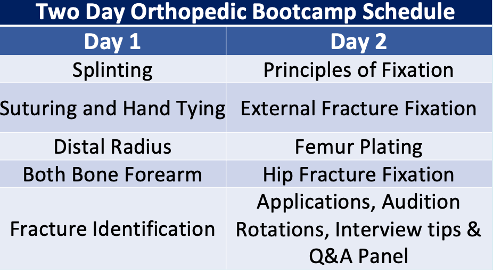
Each bootcamp spanned two consecutive days and was held at the hospital. The curriculum consisted of didactic sessions and hands-on sawbone workshops. The event ended with a panel discussion and a question-and-answer session to help the medical students with expectations of audition rotations and the application process. Figure 1 outlines the bootcamp schedule and session topics.
The medical students completed a multiple-choice test before and after the bootcamp. The test included questions on orthopedic anatomy, radiographic interpretation principles, orthopedic classifications, and procedural knowledge. The test difficulty remained consistent throughout all four years. Scores were then reported as percentages, and paired t-tests were used to compare pre- and post-test results. A p-value <0.05 was considered statistically significant.
Results
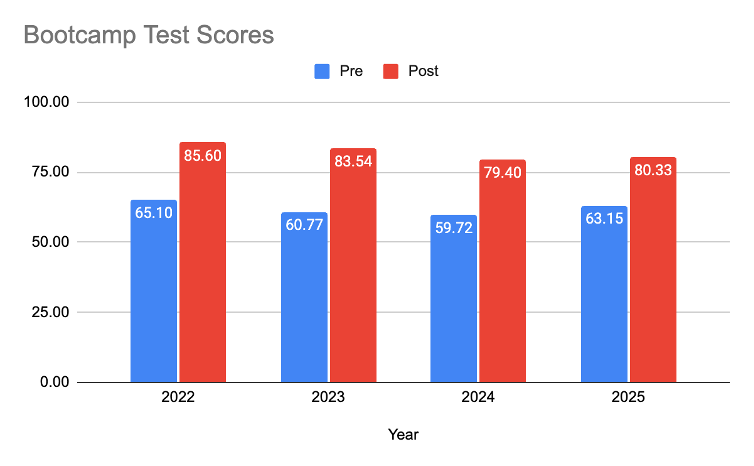
The overall average pre-bootcamp score was 62.18% (SD ± 17.59%), and the average post-bootcamp score rose to 82.31% (SD ± 12.28%). There was a statistically significant improvement in test scores (p<0.0001) from pre-test to post-test. This result is carried out throughout all four years. See Figure 2 for year specific data.
While formal survey data was not collected consistently over the four years, anecdotal feedback and end-of-bootcamp surveys collected indicated increased enthusiasm for orthopedic surgery, interest in the hospital, appreciation of expectations of audition rotations, and a better understanding of the process of matching into orthopedic surgery.
Discussion
Our findings support the implementation of orthopedic bootcamps as an effective educational tool for medical students. All of our cohorts from 2022 to 2025 demonstrated statistically significant improvements in test scores, signifying that these bootcamps can improve baseline orthopedic knowledge. These findings are consistent with prior literature showing that surgical bootcamps enhance medical student preparedness, confidence, and procedural skills. (5, 6, 10)
Hands-on learning and structured mentorship are essential components of early exposure and long-term success, especially in orthopedic surgery. (5, 11) The bootcamp provides targeted skills and knowledge that assist the medical students during their audition rotations. It allowed students to apply the didactic knowledge in an immediate and practical setting, helping to bridge the gap between classroom learning and clinical performance, as indicated in the test scores. Although learning and understanding is the highest priority, there is still room for improvement in test scores. We could further reinforce the ideas by standardizing the resident-led sawbone stations. There are five tables that have residents leading the medical students through the hands-on portion. By giving the residents points to highlight and reinforce, this standardization could further solidify the medical students’ knowledge.
The positive outcomes of the bootcamp may be particularly important for osteopathic medical students, who often face challenges in the orthopedic surgery residency match. Barriers to lack of home programs, fewer research opportunities, and less mentorship can place these students at a disadvantage. (7) Many of the students are looking towards other web-based or orthopedic surgery-specific books to increase their knowledge. They are also looking towards organizations to help make those critical connections. As the match continues to become increasingly competitive, bootcamps like the hospital’s bootcamp can encourage and assist medical students who may not have the same opportunities. Since many programs state that audition rotations are a critical part of the application, preparing students for these rotations is likely to improve match outcomes. In addition, these bootcamps are a critical way of introducing the hospital’s orthopedic surgery program to a broader group of medical students.
While our study is limited by sample size and lack of long-term follow-up, the consistent results over four years support the reproducibility of this model. Future studies should address long-term retention or performance during clinical rotations. This could be assessed through audition rotation evaluations, match rates, or sustained interest in the specialty. Future work could also investigate the match data: the number of the students attending the bootcamp who matched into an orthopedic surgery residency. Another factor that could be investigated is the improvement in scores between the classes. When we originally began collecting data, all identifying information was anonymous. However, now we have started including graduation year to try to stratify the data.
Conclusion
Overall, our findings suggest that orthopedic bootcamps provide valuable educational opportunities for medical students. We are addressing gaps in exposure and helping medical students gain knowledge and confidence with their orthopedic surgical skills. Expanding the bootcamps across different programs or regions is likely to help prepare the next generation of orthopedic surgeons and increase opportunities for more medical students.
References
- “Charting outcomes: Demographic characteristics of applicants in the main residency match® and SOAP®”. NRMP. May 29, 2025.
- “Results and data: 2024 Main Residency Match”. NRMP. September 4, 2024
- Aiyer AA, Mody KS, Dib AG, et al. Medical student mentorship in orthopaedic surgery. Journal of the American Academy of Orthopaedic Surgeons. 2021;29(16):681-690. doi:10.5435/jaaos-d-20-01274
- Bevilacqua LA, Simon J, Rutigliano D, et al. Surgical boot camp for fourth-year medical students: Impact on objective skills and subjective confidence. Surgery. 2020;167(2):298-301. doi:10.1016/j.surg.2019.06.041
- Bhashyam AR, Dyer GS. “Virtual” Boot camp: Orthopaedic intern education in the time of COVID-19 and beyond. Journal of the American Academy of Orthopaedic Surgeons. 2020;28(17). doi:10.5435/jaaos-d-20-00559
- Khan U, Bakhiet A. Implementing a unique immersive near-peer-led clinical skills educational bootcamp for early-year clinical medical students. Postgraduate Medical Journal. 2021;98(1160):415-419. doi:10.1136/postgradmedj-2020-139233
- Modica A, Ranson R, Williamson T, Ponce BA, Cohn RM, Bitterman AD. Osteopathic students have decreased match rates in orthopaedic surgery compared with allopathic students. JBJS Open Access. 2024;9(2). doi:10.2106/jbjs.oa.24.00027
- Orner CA, Soin SP, Mahmood B, Gorczyca JT, Nicandri GT, DiGiovanni BF. Increasing the educational value of the orthopaedic subinternship: The design and implementation of a fourth-year medical student curriculum. JAAOS: Global Research and Reviews. 2021;5(1). doi:10.5435/jaaosglobal-d-20-00240
- Quan T, Gu A, Agarwal AR, et al. The impact of a virtual orthopaedic surgery symposium on medical students: Increasing awareness and knowledge of the field. JBJS Open Access. 2022;7(4). doi:10.2106/jbjs.oa.22.00077
- Young M, Lewis C, Kailavasan M, et al. A systematic review of methodological principles and delivery of surgical simulation bootcamps. The American Journal of Surgery. 2022;223(6):1079-1087. doi:10.1016/j.amjsurg.2021.10.044
- Yu HH, Lockwood WC, Shaw KG, Scott FA. Formal orthopaedic surgery “Boot camp” curriculum to optimize performance on acting internships. Journal of the American Academy of Orthopaedic Surgeons. 2021;30(6):247-254. doi:10.5435/jaaos-d-21-00770