1Moore J, 2DeFroda S
1Midwestern University, Arizona, Glendale, AZ, United states; 2University of Missouri, School of Medicine, Columbia, MO, United states
Introduction
Articular cartilage defects of the knee present a significant challenge in orthopedic practice, particularly after failed surgical repair. Osteochondral allograft transplantation (OCAT) offers a restorative option for large lesions, though revision OCAT has historically inferior outcomes compared to primary cases. The Missouri Osteochondral Preservation System (MOPS®) preserves chondrocyte viability for up to 56 days, with >70% viable cell density at transplantation. This study investigates whether revision OCAT using MOPS-preserved, high-viability grafts can provide clinical outcomes comparable to primary OCAT.
Methods
Prospective registry of OCAT patients between 2016–2024 was reviewed. Patients undergoing primary or revision OCAT using MOPS-preserved grafts were included. Revision cases had;1 prior cartilage procedure, categorized into marrow stimulation, osteochondral, or cell-matrix-based interventions. Surgical technique involved press-fit cylindrical or shell grafts saturated with autologous bone marrow aspirate. Postoperative rehabilitation followed standardized protocols. Outcomes included patient-reported scores, satisfaction, and graft survival. Successful treatment was defined as a return to function without revision or arthroplasty. Comparisons were made using t-tests, ANOVA, and Fisher exact tests (p<.05).
Results
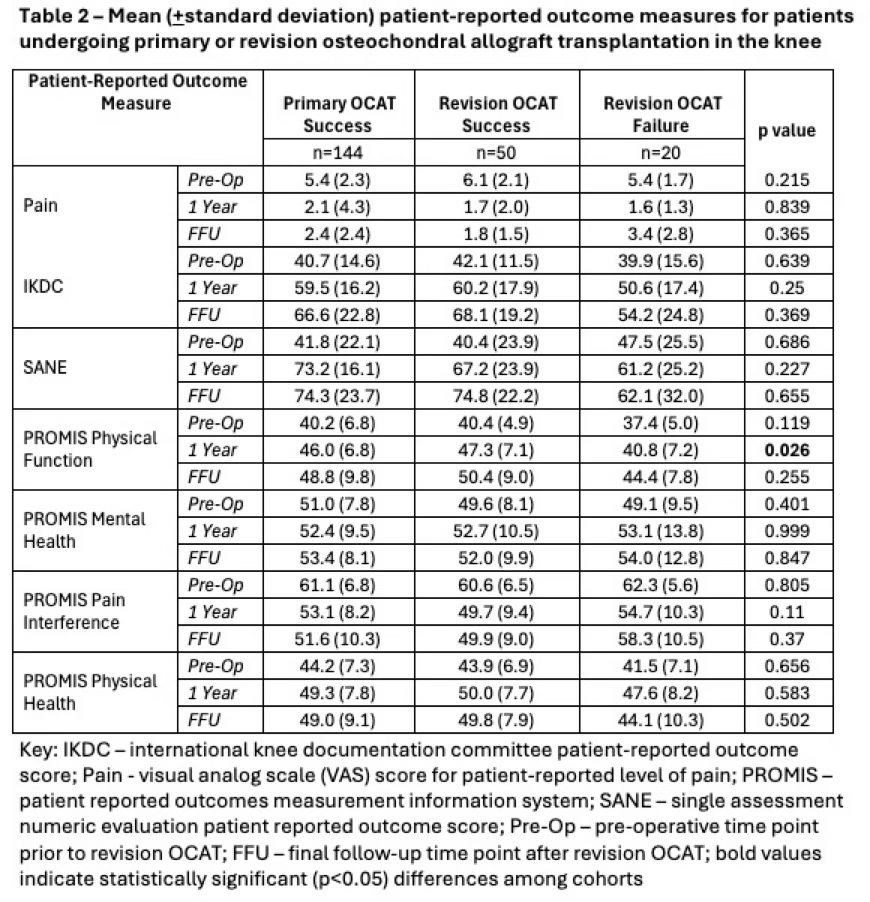
A total of 252 OCAT procedures (182 primary, 70 revision) were analyzed. At a mean 43-month follow-up, graft survival was 79.1% for primary and 71.4% for revision OCAT; overall functional survival was 84% and 80%, respectively (Table 1). Mean viable chondrocyte density at the time of transplantation was 91.6% in revision grafts. Revision OCAT following failed cell-matrix procedures had significantly higher graft survival (100%, p=.049) and fewer tibiofemoral bipolar reconstructions (p=.032). Statistically significant within-group improvements in pain and patient reported-outcome scores were observed in both primary and revision success groups at one year and final follow-up (ANOVA, Table 2).
Conclusions
Revision OCAT using MOPS®-preserved grafts yields encouraging clinical outcomes, with functional success rates and patient-reported improvements approaching those of primary procedures. These findings reinforce the osteopathic principle that structure and function are reciprocally interrelated: allografts with more viable cytostructure promote more effective biological integration and joint restoration. This study validates the importance of advanced preservation technology in optimizing outcomes for complex revision cases of osteochondral lesions.