
John P Walsh, DO, Orthopaedic Surgery Resident1; Alexander J Baur, DO, Research Assistant2; Taylor Anthony, DO, Orthopaedic Surgery Resident1; Daniel D Lee, MD Department Orthopaedic Surgery3
1Valley Hospital Medical Center
2Liberty University
3Desert Orthopaedic Center & Valley Hospital Medical Center
DOI: http://doi.org/10.70709/m34mp6iwp0w4qm
Abstract
Background
Online reviews increasingly shape patient perceptions of spine surgeons, yet prior studies report conflicting findings, often rely on legacy physician-rating websites, and incompletely account for surgeon- and practice-level confounders. We performed a contemporary analysis of Google Reviews among academic spine surgeons to quantify review volume, one-star review frequency, and associations with average ratings.
Methods
Cross-sectional survey of Google reviews included all spine fellowship program directors with Google reviews available to review December 2025. Data from 104 surgeons was extracted including, total review numbers and one-star reviews. One-star reviews were explored for common themes. Data were descriptively summarized, and one-star reviews were qualitatively assessed and thematically coded. Pearson correlation used to test associations. Comparisons between surgeon-related and non–surgeon-related review themes were performed using Fisher’s exact test.
Results
Our study analyzed 5,997 Google reviews, including 206 one-star reviews. The median number of reviews per surgeon was 23 (0-511). The median number of one-star reviews per surgeon ranged was 1 (0-14). Median rating of surgeons was 4.7 (3.3-5.0). Higher total review counts were significantly associated with higher average ratings (r = 0.24, p = 0.02). Among 206 one-star reviews, 140 (68.0%) were related to the surgeon, while 55 (26.7%) were attributed to non–surgeon factors. Surgeon-related reviews more frequently cited communication and bedside manner concerns (P = .003) and dissatisfaction with treatment decisions (P < .0001). Non–surgeon-related reviews more commonly involved access and availability (P < .0001), clinic efficiency (P < .0001), and billing issues (P = .006).
Conclusion
Google ratings of academic spine surgeons were generally favorable but demonstrated wide variability in review volume. Higher total review counts were associated with higher average ratings. One-star reviews followed consistent patterns, with surgeon-related complaints primarily reflecting communication and treatment decisions, while non–surgeon-related complaints most often involved access, clinic efficiency, and administrative factors.
Keywords: Orthopaedic surgeons, spine, patient satisfaction, quality improvement, Google reviews, online reputation
Introduction
Selecting a surgeon represents a consequential decision for patients, often influenced by a combination of physician referrals, institutional reputation, insurance considerations, and personal recommendations1–9. In recent years, online patient review platforms have emerged as an additional and increasingly visible source of information10,11. Prior studies across medical and surgical specialties demonstrate that online physician reviews are often sparse and right-skewed, with ratings disproportionately reflecting nonclinical aspects of care, including communication style, perceived empathy, clinic efficiency, and interactions with administrative staff12–17.
Within orthopaedic surgery, online physician reviews are predominantly favorable, with a large retrospective analysis by Berns et al. demonstrating that 81% of reviews were positive18. Negative online reviews across orthopaedic subspecialties, predominantly emphasize patient experience factors such as bedside manner, communication, wait times, and clinic staff interactions rather than treatment related aspects of care13,19–23. Across orthopaedic subspecialties, and particularly within spine surgery, patients most frequently cited persistent pain as the primary treatment-related concern in negative online reviews20,24.
Spine surgery is particularly relevant within the study of online surgeon reviews given the chronicity of symptoms, high patient expectations, and complex treatment decisions that characterizes spine surgery25,26. Prior studies report conflicting conclusions regarding whether online review volume meaningfully influences surgeon ratings and whether negative reviews primarily reflect surgeon-related factors or office and access-related experiences14–16,20,24,27–29. Additionally, much of the existing literature does not adequately control for surgeon- and institution-level confounders and relies on legacy physician rating platforms with declining patient use and limited public visibility compared with Google Reviews, thereby limiting the relevance of prior findings to contemporary patient behavior.
As online physician reviews increasingly shape patient perceptions, and existing studies lack contemporary analyses that account for surgeon and institutional factors, we evaluated Google Reviews of academic spine surgeons. The primary objective of this study was to quantify total Google review volume, one-star review frequency, and average ratings among spine fellowship program directors. Secondary objectives were to examine the association between review volume and average ratings, and to qualitatively analyze negative reviews to distinguish surgeon-related from non–surgeon-related complaints and identify common sources of dissatisfaction.
Methods
This study was a cross-sectional analysis of publicly available Google reviews for academic spine surgeons serving as fellowship program directors. A comprehensive list of spine fellowship program directors was compiled using publicly available fellowship program listings provided by the North American Spine Society (NASS). All individuals identified as serving in a spine fellowship program director role for the 2025-2026 academic year were eligible for inclusion. Spine fellowship program directors were selected to provide a broad, standardized proxy for surgeon expertise, practice environment, institutional credibility, and geographic variation, thereby limiting heterogeneity from key potential confounders. Existing literature suggests no meaningful differences in clinical outcomes between orthopaedic-trained and neurosurgically trained spine surgeons.
Publicly available Google review data were collected December 2025, using the standard Google search engine and Google Maps platform. Google was selected due to its widespread use, accessibility to patients, and availability of publicly viewable reviewer profiles. For each surgeon, the total number of Google reviews and the average star rating were recorded.
For each included review, the following variables were recorded: whether the review content was primarily surgeon-related or non–surgeon-related, and the primary complaint theme. Surgeon-related reviews were defined as those commenting on the surgeon’s communication, bedside manner, or clinical decision-making, including perceived treatment outcomes. Non–surgeon-related reviews were defined as those describing issues related to clinic operations, access to care, administrative processes, billing, or interactions with nonphysician staff. Negative reviews were defined as those assigned a one-star rating. Reviews consisting solely of a star rating without accompanying text were excluded for qualitative analysis. All eligible one-star reviews were independently reviewed by two investigators (AJB and TA), blinded to each other’s assessments.
Complaint themes were categorized using a predefined coding framework developed by the study authors. The themes were adapted from previous studies examining negative reviews in spine surgery15,20,24. The framework included communication and bedside manner, dissatisfaction with treatment decisions, persistent symptoms or unmet expectations, access and availability, clinic efficiency, coordination of care, billing-related concerns, and complications. Reviews could be assigned to more than one thematic category when applicable. Discrepancies in thematic assignment between reviewers were resolved through consensus discussion.
Data Analyses
Data were recorded in Microsoft Excel and analyzed using R (R Foundation for Statistical Computing, Vienna, Austria). Continuous variables were summarized using medians and ranges due to non-normal distributions. Categorical variables were reported as frequencies and percentages. Associations between total review volume and one-star review frequency, as well as total review volume and average rating, were assessed using Pearson correlation coefficients. Comparisons between surgeon-related and non–surgeon-related review themes were performed using Fisher’s exact test. Statistical significance was defined as a two-sided P value < 0.05.
Results
A total of 104 spine fellowship program directors with publicly available Google reviews were included in the analysis. A total of 5,997 Google reviews were included in analysis. The number of Google reviews per surgeon ranged from 0 to 511, demonstrating a markedly right-skewed distribution with a median of 23 reviews (Figure 1). A substantial proportion of surgeons had relatively few reviews, while a small number accounted for a disproportionately high review volume. Overall surgeon ratings were favorable, with a median average rating of 4.7 (range, 3.3 to 5.0) (Figure 2). The majority of surgeons maintained high average ratings despite variability in review volume.
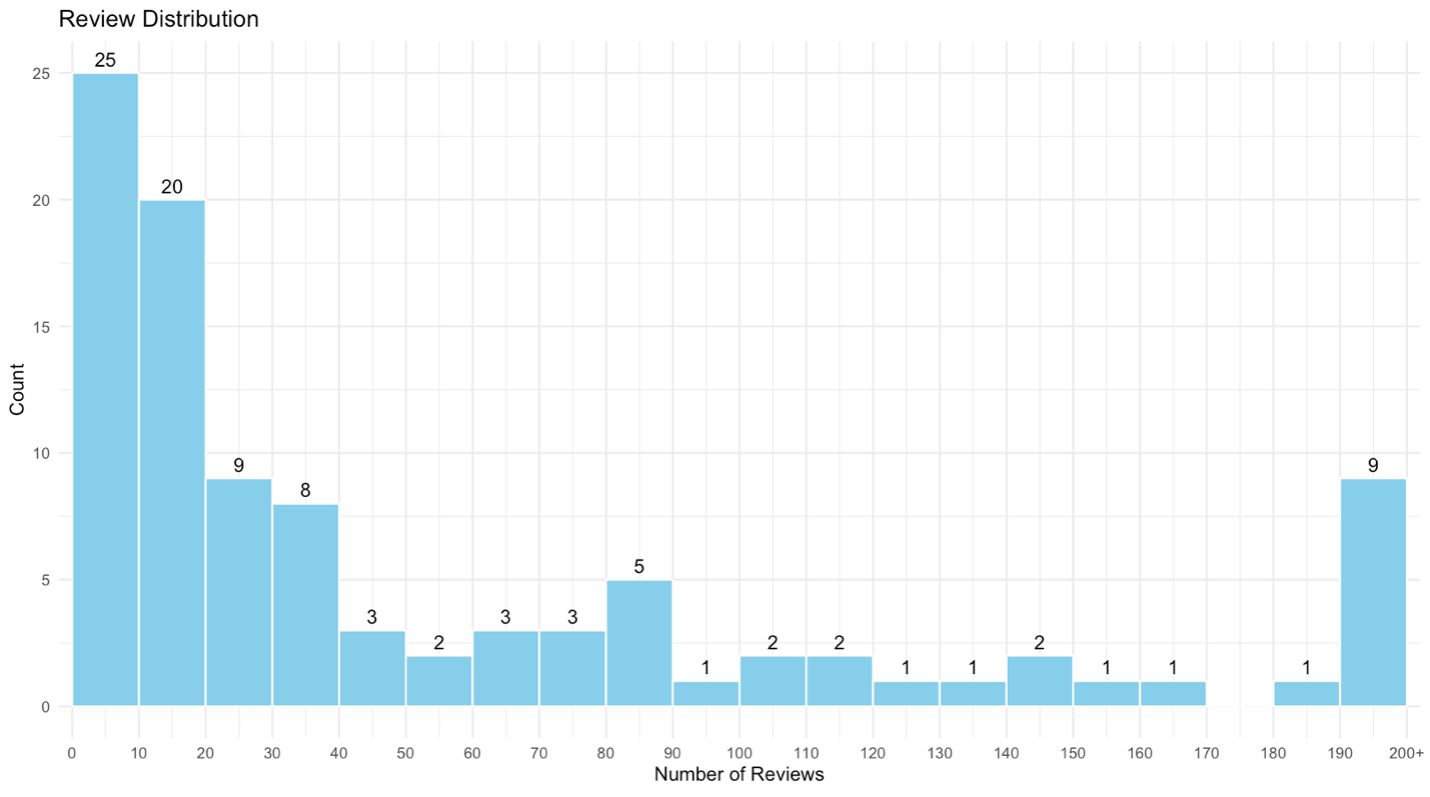

The number of one-star reviews per surgeon ranged from 0 to 14, with a median of 1 one-star review per surgeon. Total Google review volume was positively associated with average rating (r = 0.24; P = 0.02) and one-star review frequency (r = 0.36; P = 0.0002).
A total of 206 one-star reviews were included for qualitative analysis. Of these, 140 reviews (68.0%) were classified as surgeon-related, while 55 reviews (26.7%) were attributed to non–surgeon-related factors. The remaining reviews contained insufficient information for definitive classification.
Among surgeon-related one-star reviews, the most frequently cited complaint themes included dissatisfaction with treatment decisions (61 of 140), communication and bedside manner concerns (52 of 140), and persistent symptoms or unmet expectations (30 of 140). Complaints related to coordination of care and clinic efficiency were less common within surgeon-related reviews (Table 1). In contrast, non–surgeon-related reviews more frequently cited access and availability issues (23 of 55), clinic efficiency concerns (15 of 55), and billing-related complaints (9 of 55). Coordination of care issues were also more commonly reported in non–surgeon-related reviews than in surgeon-related reviews.
Comparative analysis demonstrated that surgeon-related one-star reviews were significantly more likely to reference treatment decisions (P < .0001), communication and bedside manner (P = .003), and persistent symptoms (P = .01). In contrast, non–surgeon-related reviews were significantly more likely to involve access and availability (P < .0001), clinic efficiency (P < .0001), coordination of care (P = .006), and billing concerns (P = .006).
Table 1: 1 & 2 Star Review Themes
| Review About Surgeon? | P-Value | ||
| Yes | No | ||
| 1 Star Reviews | 140 | 55 | |
| Persistent Symptoms | 30/140 | 2/55 | .01 |
| Coordination of Care | 3/140 | 6/55 | .006 |
| Treatment Decision | 61/140 | 3/55 | <.0001 |
| Access/Availability | 1/140 | 23/55 | <.0001 |
| Communication | 52/140 | 5/55 | .003 |
| Clinic Efficiency | 10/140 | 15/55 | <.0001 |
| Billing | 8/140 | 9/55 | .006 |
| Complications | 41/140 | N/A | |
Persistent Symptoms: Dissatisfaction with pain, function, or recovery not aligning with expectations.
Coordination of Care: Inconsistent communication between surgical, rehab, and primary care teams; fragmented care; poor discharge instructions.
Treatment Decision: Dissatisfaction with the recommended treatment plan, including disagreement with operative versus nonoperative management
Access/Availability: Barriers to timely access or communication, including difficulty scheduling appointments, limited availability, poor responsiveness to patient inquiries, and inadequate follow-up.
Communication/Bedside manner: Rushed appointments, perceived rudeness, lack of empathy, poor listening, not answering questions.
Clinic Efficiency: Long in-clinic wait times, inefficient clinic flow, delays in surgery scheduling or imaging.
Billing: Surprise billing, unclear insurance coverage, high out-of-pocket expenses, confusion over what was elective vs. necessary.
Professionalism: Dismissive behavior, bias (age, race, weight, gender), lack of bedside manner.
Complications: Surgical errors/complications (e.g., infection, stiffness, DVT), and perception of poor surgical skill.
Discussion
This study provides a quantitative and qualitative evaluation of Google reviews for academic spine surgeons serving as fellowship program directors, with a specific focus on the prevalence and drivers of negative reviews. Despite inclusion of high-profile academic surgeons, Google review volume varied substantially, and higher Google review volume was associated with higher average ratings. Negative reviews were observed even among surgeons with high overall ratings, with the majority classified as surgeon-related. Surgeon-related negative reviews most commonly reflected concerns regarding communication and treatment recommendations, whereas non–surgeon-related reviews primarily involved access, clinic efficiency, and administrative processes.
A key strength of this study is the composition of the included cohort. Restricting the analysis to spine fellowship program directors allowed for broad control of surgeon- and institution-level factors, including perceived expertise, practice environment, institutional credibility, and geographic variation, thereby reducing heterogeneity from major potential confounders. Within this relatively standardized cohort, overall Google ratings were substantially higher than those reported by Lee et al. in their analysis of academic surgeons, suggesting that highly visible academic spine surgeons maintain favorable public ratings despite variability in review volume30. Our findings add to prior large-scale analyses by Artz et al. and Brinkman et al., who evaluated 16,695 online reviews and 6,286 reviews without controlling for surgeon expertise or practice environment20,24. Despite differences in study design and cohort selection, our results align with both investigations in identifying bedside manner and communication as prominent drivers of one-star reviews, underscoring the consistent influence of patient–physician interactions on online evaluations.
An additional strength of this study is the exclusive focus on Google Reviews, which represent one of the most publicly visible and frequently accessed source of information regarding physicians31,32. Google Reviews are prominently displayed during routine internet searches for surgeons and are easily accessible for large language models, amplifying their influence on patient perceptions33. By focusing on a single, highly visible platform, our analysis provides contemporary insight into the type of information most readily encountered by patients when seeking spine care. Our findings further corroborate prior work by Tang et al., who demonstrated that poorly managed pain was a common contributor to negative online reviews in a retrospective analysis of 480 surgeons on Healthgrades.com15. The consistency of this observation across different review platforms suggests that pain management and expectation setting remain central determinants of patient dissatisfaction, even among high-profile academic spine surgeons.
These findings have direct relevance to contemporary practice management and patient engagement strategies. The observed association between higher review volume and more favorable average ratings indicates that publicly visible online scores are influenced not only by patient experience but also by how actively practices solicit and manage feedback. In this setting, aggregate ratings may reflect the systematic capture of patient reviews rather than true differences in clinical quality. Awareness of this dynamic is important for surgeons and institutions interpreting online ratings and highlights the growing role of structured review monitoring and patient outreach as components of modern practice operations34.
This study has several limitations. The cohort was restricted to spine fellowship program directors, representing a highly selected academic population that may not reflect review patterns among community-based spine surgeons. Only Google reviews were analyzed, and findings may differ across other physician review platforms. Qualitative categorization is inherently subjective despite use of a predefined coding framework and independent review. Additionally, surgeon- and practice-level variables such as procedural volume, marketing strategies, or use of reputation management services were not assessed.
Future investigations should extend this analysis to a broader spectrum of spine surgeons and directly compare review characteristics across multiple online platforms. Further work examining the influence of automated review solicitation and reputation management strategies may clarify how online feedback is generated and interpreted. Ultimately, these findings reinforce the importance of integrating online reviews into a broader framework of quality assessment that includes objective outcomes and patient-reported measures rather than relying on public ratings alone.
Conclusion
Academic spine fellowship program directors generally maintain high Google ratings, though review volume varies widely and influences overall scores. Higher review volume was associated with higher average ratings, indicating that average ratings can be influenced by number of reviews. Negative reviews followed consistent patterns, with surgeon-related concerns focused on communication and treatment decisions, and non–surgeon-related complaints involving access and clinic operations. These findings underscore the need to interpret online ratings cautiously and highlight modifiable factors affecting patient perception beyond surgical outcomes.
Funding: This research did not receive any specific grant from funding agencies in the public, commercial, or not-for-profit sectors.
References
- Wilson CT, Woloshin S, Schwartz LM. Choosing Where to Have Major Surgery. ARCH SURG. 2007;142.
- Schwartz LM, Woloshin S, Birkmeyer JD. How do elderly patients decide where to go for major surgery? Telephone interview survey. BMJ. 2005;331(7520):821. doi:10.1136/bmj.38614.449016.de
- Yahanda AT, Lafaro KJ, Spolverato G, Pawlik TM. A Systematic Review of the Factors that Patients Use to Choose their Surgeon. World j surg. 2016;40(1):45-55. doi:10.1007/s00268-015-3246-7
- Tu HT, Lauer JR. Word of mouth and physician referrals still drive health care provider choice. Res Brief. 2008;(9):1-8.
- Bozic KJ, Kaufman D, Chan VC, Caminiti S, Lewis C. Factors That Influence Provider Selection for Elective Total Joint Arthroplasty. Clinical Orthopaedics & Related Research. 2013;471(6):1865-1872. doi:10.1007/s11999-012-2640-9
- Moser A, Korstjens I, Van Der Weijden T, Tange H. Patient’s decision making in selecting a hospital for elective orthopaedic surgery. Evaluation Clinical Practice. 2010;16(6):1262-1268. doi:10.1111/j.1365-2753.2009.01311.x
- Engler ID, Ahrendt GM, Curley AJ, Musahl V. Surgeon Personality, Time Spent With the Patient, and Quality of Facilities Are the Most Important Factors to Patients in Selecting an Orthopaedic Sports Medicine Surgeon. Arthroscopy, Sports Medicine, and Rehabilitation. 2022;4(3):e1023-e1029. doi:10.1016/j.asmr.2022.02.006
- Manning BT, Ahn J, Bohl DD, Mayo BC, Louie PK, Singh K. Spine Surgeon Selection Criteria: Factors Influencing Patient Choice. Spine. 2016;41(13):E814-E819. doi:10.1097/BRS.0000000000001385
- Grabner-Kräuter S, Waiguny MK. Insights Into the Impact of Online Physician Reviews on Patients’ Decision Making: Randomized Experiment. J Med Internet Res. 2015;17(4):e93. doi:10.2196/jmir.3991
- Chen Y, Lee S. User-Generated Physician Ratings and Their Effects on Patients’ Physician Choices: Evidence from Yelp. Journal of Marketing. 2024;88(1):77-96. doi:10.1177/00222429221146511
- Hong YA, Liang C, Radcliff TA, Wigfall LT, Street RL. What Do Patients Say About Doctors Online? A Systematic Review of Studies on Patient Online Reviews. J Med Internet Res. 2019;21(4):e12521. doi:10.2196/12521
- López A, Detz A, Ratanawongsa N, Sarkar U. What Patients Say About Their Doctors Online: A Qualitative Content Analysis. J GEN INTERN MED. 2012;27(6):685-692. doi:10.1007/s11606-011-1958-4
- Arthur JR, Etzioni D, Schwartz AJ. Characterizing extremely negative reviews of total joint arthroplasty practices and surgeons on yelp.com. Arthroplasty Today. 2019;5(2):216-220. doi:10.1016/j.artd.2019.02.009
- Gupta A, Gupta R, White MD, et al. Patient satisfaction reviews for 967 spine neurosurgeons on Healthgrades. Journal of Neurosurgery: Spine. 2022;36(5):869-875. doi:10.3171/2021.8.SPINE21661
- Tang JE, Arvind V, Dominy C, White CA, Cho SK, Kim JS. How Are Patients Reviewing Spine Surgeons Online? A Sentiment Analysis of Physician Review Website Written Comments. Global Spine Journal. 2023;13(8):2107-2114. doi:10.1177/21925682211069933
- Donnally CJ, Roth ES, Li DJ, et al. Analysis of Internet Review Site Comments for Spine Surgeons: How Office Staff, Physician Likeability, and Patient Outcome Are Associated With Online Evaluations. Spine. 2018;43(24):1725-1730. doi:10.1097/BRS.0000000000002740
- Liu C, Uffenheimer M, Nasseri Y, Cohen J, Ellenhorn J. “But His Yelp Reviews Are Awful!”: Analysis of General Surgeons’ Yelp Reviews. J Med Internet Res. 2019;21(4):e11646. doi:10.2196/11646
- Berns EM, Reid DBC, Anderson GM, et al. Analysis of Patients’ Online Reviews of Orthopaedic Surgeons. JAAOS Glob Res Rev. 2022;6(10). doi:10.5435/JAAOSGlobal-D-22-00074
- Richman EH, Kuttner NP, Foster LO, et al. Characterizing Single-star Negative Online Reviews of Orthopaedic Trauma Association Members. J Am Acad Orthop Surg. 2023;31(8):397-404. doi:10.5435/jaaos-d-22-00631
- Brinkman JC, Pollock JR, Arthur JR, Smith J, Lin K, Chang MS. Characterizing negative reviews of orthopedic spine surgeons and practices. North American Spine Society Journal (NASSJ). 2022;11:100126. doi:10.1016/j.xnsj.2022.100126
- Pollock JR, Arthur JR, Smith JF, et al. The Majority of Complaints About Orthopedic Sports Surgeons on Yelp Are Nonclinical. Arthroscopy, Sports Medicine, and Rehabilitation. 2021;3(5):e1465-e1472. doi:10.1016/j.asmr.2021.07.008
- Richman EH, Ogbaudu E, Pollock JR, et al. Characterizing Negative Online Reviews of Pediatric Orthopaedic Surgeons. Journal of Pediatric Orthopaedics. 2022;42(5):e533-e537. doi:10.1097/BPO.0000000000002121
- Hitchman KJ, Baumann AN, Welch SE, Anastasio AT, Walley KC, Eward W. Assessing extremely negative online patient reviews and complaints of musculoskeletal oncology surgeons in the United States: a retrospective analysis. J Orthop Surg Res. 2024;19(1):425. doi:10.1186/s13018-024-04881-y
- Artz N, Dalton J, Ramanathan R, et al. Characterizing Negative Online Reviews of Spine Surgeons. Spine. 2024;49(11):E154-E163. doi:10.1097/BRS.0000000000004962
- Tabibian BE, Kuhn EN, Davis MC, Pritchard PR. Patient Expectations and Preferences in the Spinal Surgery Clinic. World Neurosurgery. 2017;106:595-601. doi:10.1016/j.wneu.2017.07.018
- Aoude A, Litowski M, Aldebeyan S, et al. A Comparison of Patient and Surgeon Expectations of Spine Surgical Outcomes. Global Spine Journal. 2021;11(3):331-337. doi:10.1177/2192568220907603
- Tang J, Arvind V, White CA, Dominy C, Cho S, Kim JS. How are Patients Describing You Online? A Natural Language Processing Driven Sentiment Analysis of Online Reviews on CSRS Surgeons. Clinical Spine Surgery. 2023;36(2):E107-E113. doi:10.1097/BSD.0000000000001372
- Tang J, White CA, Arvind V, Cho S, Kim JS, Steinberger J. What Are Patients Saying About Minimally Invasive Spine Surgeons Online: A Sentiment Analysis of 2,235 Physician Review Website Reviews. Cureus. Published online April 13, 2022. doi:10.7759/cureus.24113
- Kalagara S, Eltorai AEM, DePasse JM, Daniels AH. Predictive factors of positive online patient ratings of spine surgeons. The Spine Journal. 2019;19(1):182-185. doi:10.1016/j.spinee.2018.07.024
- Lee KE, Alan N, Dholaria N, et al. Is There an Association Between Spine Surgeon Academic Productivity and Patient Satisfaction Ratings? Neurosurgery. 2025;97(1):98-104. doi:10.1227/neu.0000000000003292
- Chen TT, Wu CI, Chiu MHP, et al. Factors Associated with the Patient/Client Use of Report Cards, Physician Rating Websites, Social Media, and Google for Hospital and Physician Selection: A Nationwide Survey. Healthcare (Basel). 2022;10(10):1931. doi:10.3390/healthcare10101931
- Zitek T, Bui J, Day C, Ecoff S, Patel B. A cross-sectional analysis of Yelp and Google reviews of hospitals in the United States. J Am Coll Emerg Physicians Open. 2023;4(2):e12913. doi:10.1002/emp2.12913
- Said A. On explaining recommendations with Large Language Models: a review. Front Big Data. 2024;7:1505284. doi:10.3389/fdata.2024.1505284
- Online Reputation Management Market Size & Share Analysis – Growth Trends And Forecast (2025 – 2030). Published online June 16, 2025. Accessed December 18, 2025. https://www.mordorintelligence.com/industry-reports/online-reputation-management-market