1Joseph T, 2Modi K, 1Genkin M, 2Shah R, 1Genkin A, 3Markel L
1Brooklyn College, Brooklyn, NY, United states; 2Georgetown University, Washington, DC, United states; 3NYU Langone, New York, NY, United states
Introduction
Osteoporotic vertebral compression fractures (OVCFs) are a prevalent consequence of osteoporosis, especially in postmenopausal women and older adults. Affecting over 1.4 million people annually, they cause pain, reduced mobility, and heightened risk of future fractures. Conventional treatments like bracing, vertebroplasty, bisphosphonates (BP), and denosumab address bone resorption and stabilization. However, teriparatide (TPD), an anabolic parathyroid hormone analog, promotes bone formation and may accelerate fracture healing. This review evaluates TPD’s effectiveness in improving OVCF outcomes compared to alternative therapies.
Methods
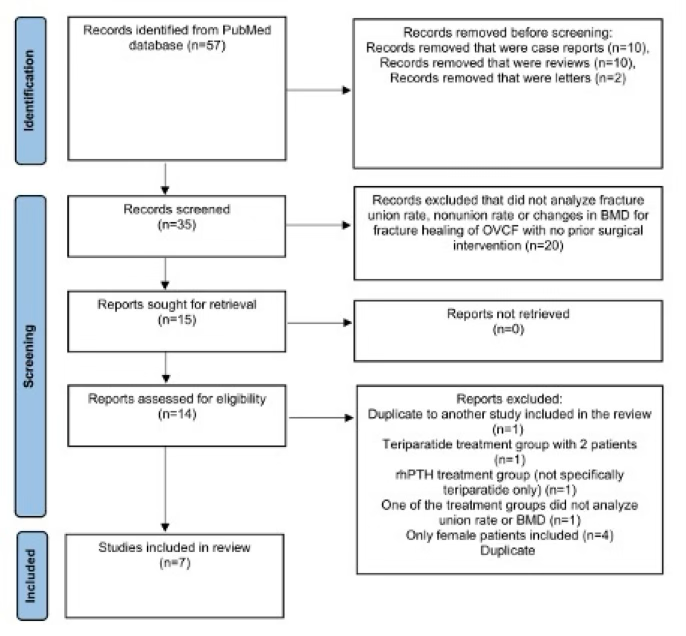
A systematic PRISMA-guided PubMed search identified 57 studies, of which 7 met criteria including outcomes for union rate, bone mineral density (BMD), kyphosis angle, Oswestry Disability Index (ODI), and Visual Analogue Scale (VAS). Studies with surgical cohorts or exclusively female populations were excluded. Data were extracted and compared across treatment groups including TPD alone and in combination with BP, vertebroplasty, denosumab, or Wharton’s jelly-derived mesenchymal stem cells (WJ-MSCs).
Results
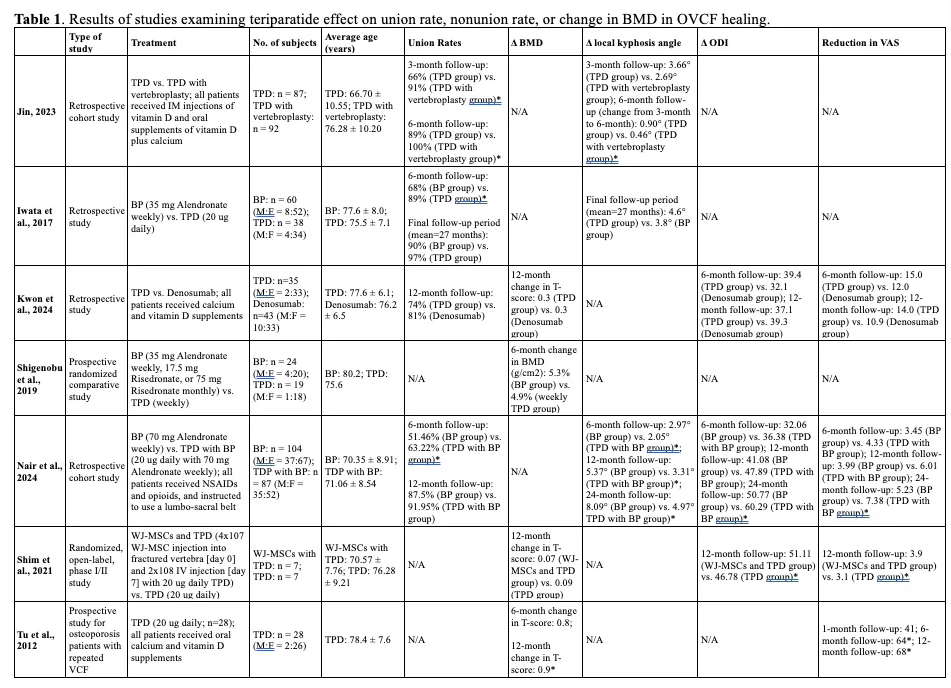
TPD produced union rates of 74–100%, exceeding BP (61–97%) at early follow-ups. Combination with vertebroplasty achieved 91.4% union at 3 months and 100% at 6 months. TPD improved BMD up to 4.9% and showed faster healing than BP. ODI and VAS improved more in TPD groups, particularly with combination therapy. TPD and denosumab showed no significant differences in BMD or union rates. WJ-MSC and TPD combination improved VAS and ODI at 12 months but showed no BMD advantage.
Discussion
Teriparatide consistently enhanced fracture healing, BMD, and functional outcomes compared to anti-resorptive agents. Its anabolic effects accelerated union and reduced kyphotic progression. Combined TPD-vertebroplasty therapy delivered both mechanical and biological benefits. Denosumab offered similar long-term results but lacked TPD’s early anabolic impact. While WJ-MSCs improved pain and disability outcomes, long-term effects on bone quality require further study. These findings support broader use of TPD—alone or in combination—in OVCF management to improve healing and reduce complications.